
Time containers and fades
| Component | Props | What it does |
|---|---|---|
Sequence |
from, duration: Option<f32>, children |
shows children from from seconds, for duration or until the parent ends |
Series |
items: Vec<(f32, Children)>, overlap |
children back to back, each for its seconds; overlap starts each one earlier |
Loop |
duration, times: Option<usize>, children |
repeats children every duration seconds |
Freeze |
at, children |
children frozen at at seconds of their time |
Fill |
background: Option<Color>, children |
full-canvas group (Remotion’s AbsoluteFill) |
FadeIn |
shift, delay, run_time, rate_func |
Enter: fades in while moving by shift into place; fade.apply(ui, content) |
FadeOut |
shift, delay, run_time, rate_func |
Exit: fades out before the end of ui.duration (delay seconds before it) |
Gallery scenes: Sequence, Series, Loop, Freeze, FadeIn, FadeOut, Fill.
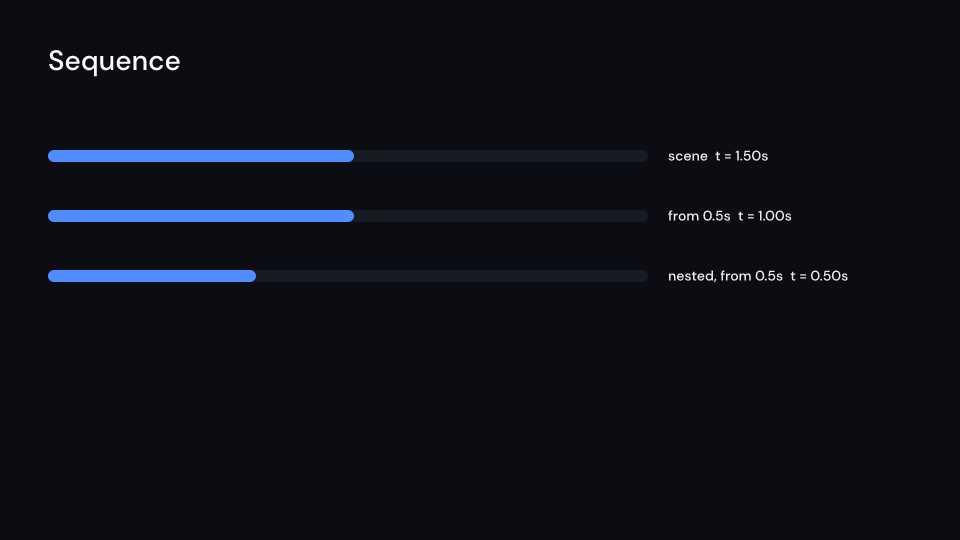
Sequence 3 s
Series 3 s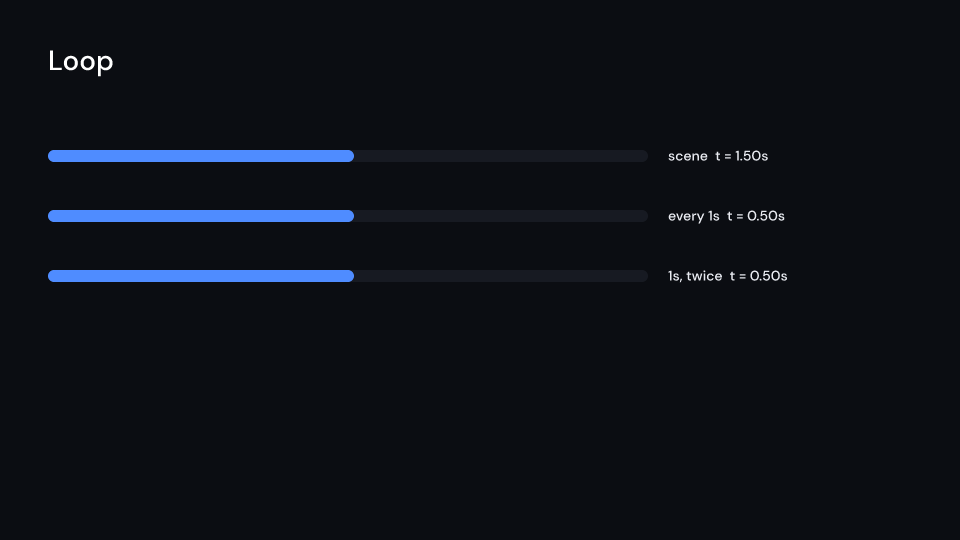
Loop 3 s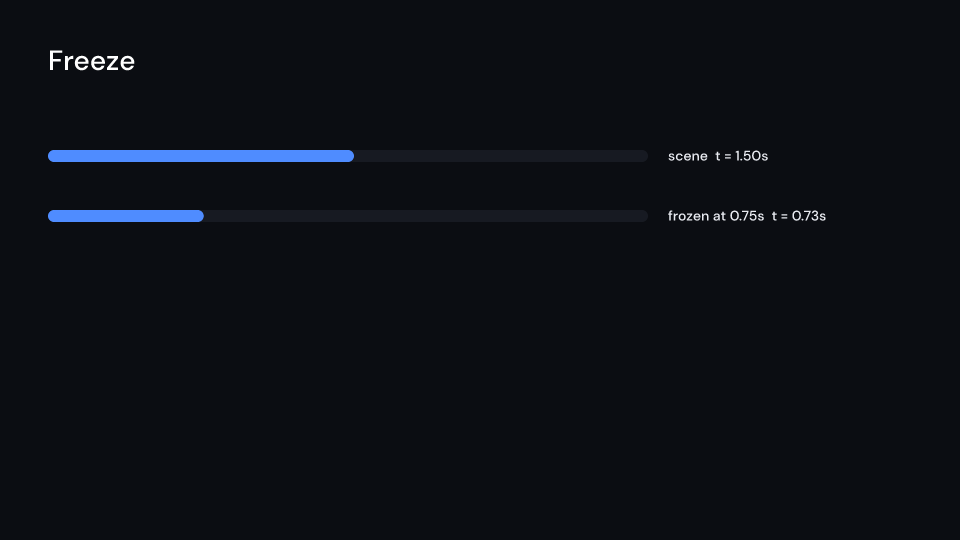
Freeze 3 s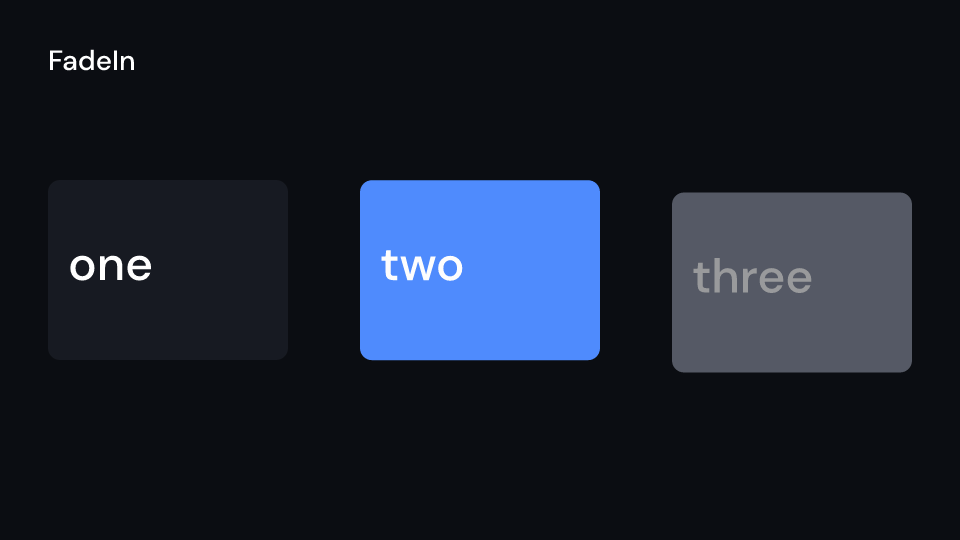
FadeIn 2 s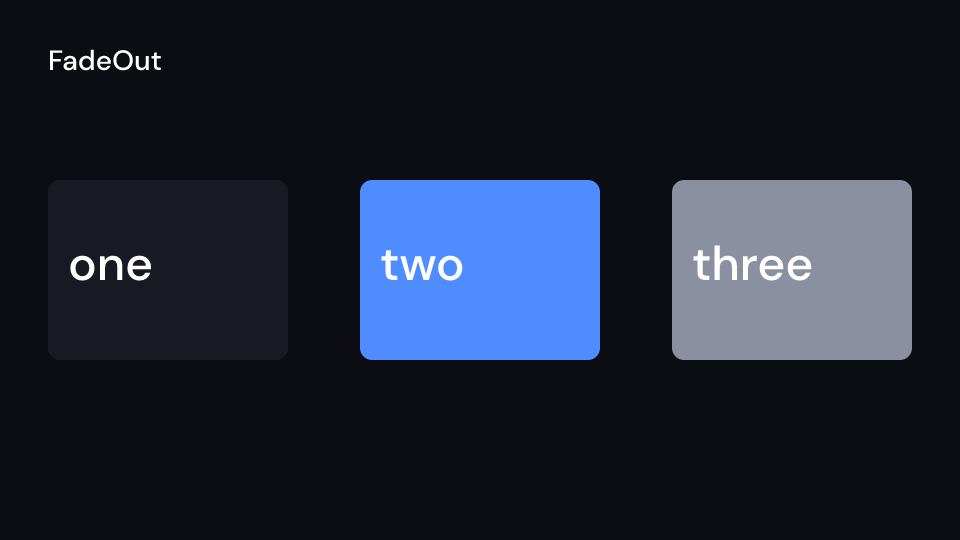
FadeOut 2 s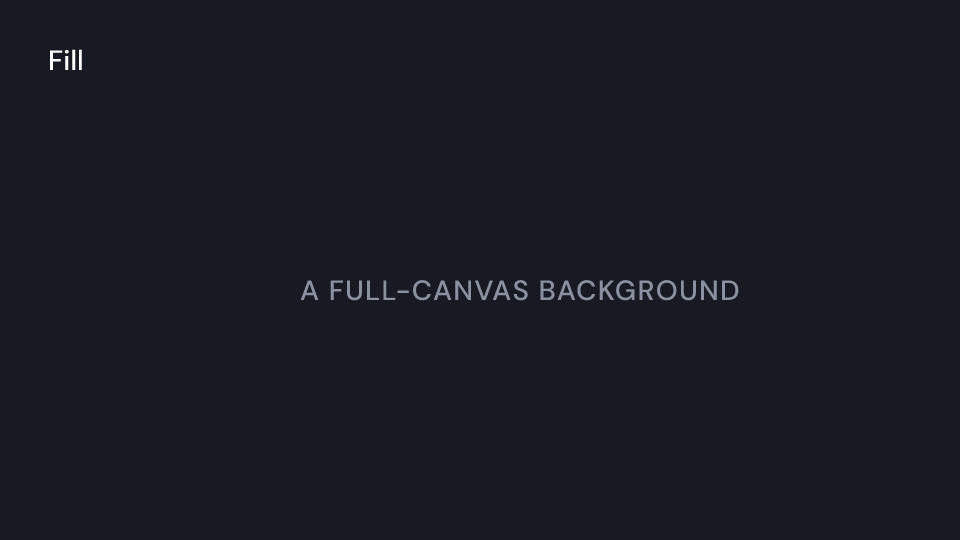
Fill 2 sRepeat a local animation, or hold it at a particular local time:
use fframes_kit::prelude::*;
fn timed<'a>(ui: &mut Ui<'a, '_, '_>) -> Svgr<'a> {    let sequence = ui.show(Sequence {        from: 0.5, duration: Some(1.0),        children: children(|ui| ui.show(Dot { ..ui.defaults() })),    });    let series = ui.show(Series {        items: vec![            (1.0, children(|ui| ui.show(Circle { ..ui.defaults() }))),            (1.0, children(|ui| ui.show(Square { ..ui.defaults() }))),        ],        overlap: 0.0,    });    let repeated = ui.show(Loop {        duration: 2.0, times: Some(3),        children: children(|ui| ui.show(Circle { enter: Some(Create::default().into()), ..ui.defaults() })),    });    let frozen = ui.show(Freeze {        at: 0.5,        children: children(|ui| ui.show(Square { enter: Some(Create::default().into()), ..ui.defaults() })),    });    let fill = ui.show(Fill {        background: Some(ui.theme.colors.background),        children: children(|ui| ui.show(Circle { cx: 1200.0, cy: 540.0, radius: 80.0, ..ui.defaults() })),    });    svgr!(<g>{fill}{sequence}{series}{repeated}{frozen}</g>)}
RateFunc has Manim’s names: Smooth (default), Linear, RushInto, RushFrom,
ThereAndBack, DoubleSmooth, plus Easing(fframes::animation::Easing) for CSS curves and
springs. motion has progress, clamp01, lerp, stagger(i, step), spring, hash,
noise, the easing curves expo_in, expo_out, cubic_in_out and quart_out on 0..=1,
timecode(frames, fps) (hh:mm:ss:ff, an error for 0 fps) and thousands(n) (12,480).
use fframes_kit::prelude::*;
assert_eq!(motion::progress(0.5, 0.0, 2.0), 0.25);assert_eq!(RateFunc::Linear.apply(0.3, 1.0), 0.3);assert_eq!(motion::noise(7, 1.25), motion::noise(7, 1.25));assert_eq!(motion::timecode(3_725, 60).unwrap(), "00:01:02:05");assert_eq!(motion::thousands(12_480), "12,480");
For a video cut to music, Beat { period, downbeat } is the beat grid: beat 0 is the
first downbeat, at downbeat seconds, and beats are period seconds apart. It stores the
period rather than the BPM, so a measured period is used exactly; Beat::from_bpm(bpm, downbeat) makes one from a tempo. time(beat) and frame(beat, fps) place things on the
grid (frames are rounded, so scene edges never drift), beat_at(seconds) reads it back, and
snap(beats) and soft(beats) are springs released beats ago (their (stiffness, damping) are the fields snap_spring (320, 22) and soft_spring (170, 15)).
Beat::pulse(beat, sharpness) is 1 on every beat and decays until the next.
Gallery scene: Beat.
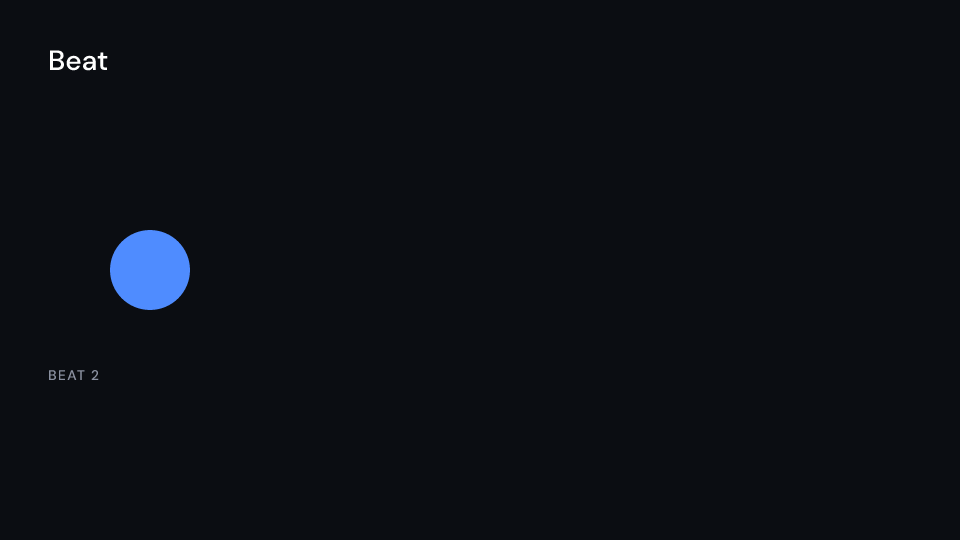
Beat 3 suse fframes_kit::prelude::*;
const GRID: Beat = Beat::new(0.5, 2.0); // 120 BPM, first downbeat at 2 s
assert_eq!(GRID.time(4.0), 4.0);assert_eq!(GRID.frame(4.0, 30), 120);assert_eq!(GRID.beat_at(3.0), 2.0);assert_eq!(Beat::pulse(3.0, 8.0), 1.0);Components are plain structs. Set the fields you need and fill the rest with ..ui.defaults(): the defaults below come from the current theme (theme. values are fields of Theme).
Sequence
Section titled “Sequence”Shows its children from from seconds on, for duration seconds or until the parent ends. Inside, time starts at 0 and ui.duration is the sequence’s length.
| Field | Type | Default | Description |
|---|---|---|---|
from |
f32 |
0.0 |
Start in the parent’s local seconds. |
duration |
Option<f32> |
None |
Length in seconds; None runs until the parent ends. |
children |
Children |
no_children() |
What it shows; a closure taking the Ui, whose time starts at 0 at from. |
Series
Section titled “Series”Children one after the other, each for its own number of seconds. Each item starts overlap seconds before the previous one ends, so both show during the overlap.
| Field | Type | Default | Description |
|---|---|---|---|
items |
Vec<(f32, Children)> |
— | (seconds, children) in play order. |
overlap |
f32 |
— | Seconds each item overlaps the one before it; 0 plays them back to back. |
Repeats its children every duration seconds, times times or forever (None).
| Field | Type | Default | Description |
|---|---|---|---|
duration |
f32 |
1.0 |
Seconds one repeat lasts. |
times |
Option<usize> |
None |
How many repeats before it stops showing; None for forever. |
children |
Children |
no_children() |
What it repeats; a closure taking the Ui whose time restarts at 0 each repeat. |
Freeze
Section titled “Freeze”Shows its children frozen at at seconds of their local time.
| Field | Type | Default | Description |
|---|---|---|---|
at |
f32 |
0.0 |
Seconds of the children’s local time to show, whatever the frame. |
children |
Children |
no_children() |
What it draws, frozen at at; a closure taking the Ui. |
A group covering the whole canvas, optionally on a background colour (Remotion’s AbsoluteFill).
| Field | Type | Default | Description |
|---|---|---|---|
background |
Option<Color> |
None |
Colour painted behind the children; None for none. |
children |
Children |
no_children() |
What it draws over the background, a closure taking the Ui. |