
VariationalAutoencoder draws ManimML’s autoencoder as a NeuralNetwork: the image input,
the feed-forward layers of the encoder (neurons per layer, [5, 3] by default), the latent
space, the decoder ([3, 5]) and the image output, both size cells square. layers()
gives these layers and latent_index() the place of the latent space among them.
- Latent space. An embedding box with a cloud of
pointspoints forseedand the 1σ and 2σ rings of its Gaussian inring_color. - Code. The image’s point in the latent space, drawn in
pulse_color, isμ + L·epsilon(Lthe Cholesky factor of the covariance, the reparameterisation trick).epsilonis in units of the standard normal distribution,(1.3, -0.7)by default; the point stays inside the box. - Forward pass. With
forward_passthe pulses run from the input to the output, and the point appears as they reach the latent space. Without one it is always shown.
Gallery scenes: VariationalAutoencoder, Vae.
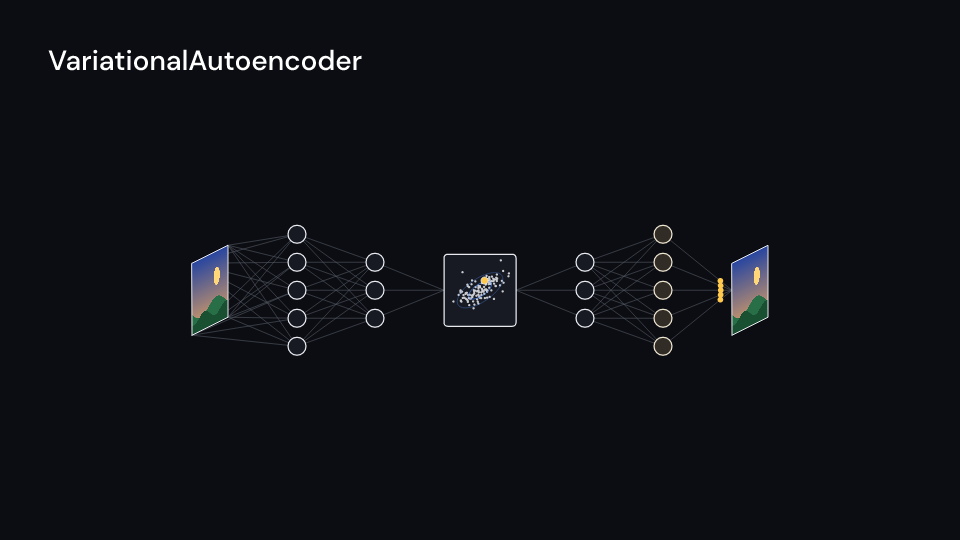
VariationalAutoencoder 5 s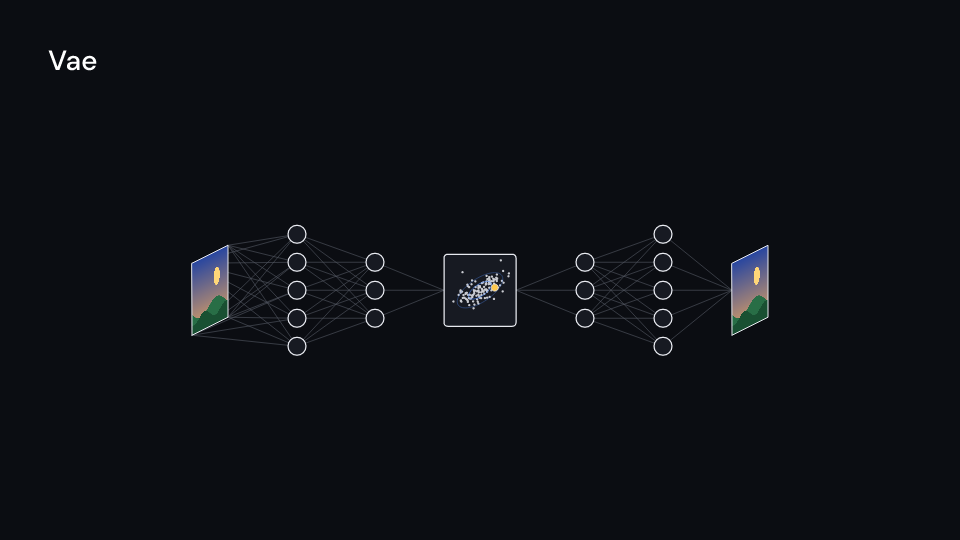
Vae 5 suse fframes_kit::prelude::*;
fn autoencoder<'a>(ui: &mut Ui<'a, '_, '_>) -> Svgr<'a> { ui.show(VariationalAutoencoder { input: "digit.png", output: "digit.png", epsilon: (0.4, 1.1), forward_pass: Some(ForwardPass { start: 0.9, duration: 3.2 }), enter: Some(FadeIn::default()), ..ui.defaults() })}Components are plain structs. Set the fields you need and fill the rest with ..ui.defaults(): the defaults below come from the current theme (theme. values are fields of Theme).
VariationalAutoencoder
Section titled “VariationalAutoencoder”| Field | Type | Default | Description |
|---|---|---|---|
input |
&str |
"" |
File name of the input image in the media folder. |
output |
&str |
"" |
File name of the reconstructed output image in the media folder. |
size |
usize |
8 |
Width and height of the images in cells, for the convolution-style maps. |
encoder |
Vec<usize> |
vec![5, 3] |
Neurons in each feed-forward layer of the encoder, from the input towards the latent space. |
decoder |
Vec<usize> |
vec![3, 5] |
Neurons in each feed-forward layer of the decoder, from the latent space towards the output. |
points |
usize |
120 |
Number of points in the cloud drawn in the latent box. |
seed |
u64 |
1 |
Seed of the point cloud; the same seed gives the same cloud on every frame and machine. |
epsilon |
(f64, f64) |
(1.3, -0.7) |
Noise of this image’s latent point, in units of the standard normal distribution (the point is the mean plus the noise scaled by the Gaussian). |
center |
(f64, f64) |
(0.0, 0.0) |
The middle of the network, in units of ui.space. |
spacing |
f32 |
130.0 |
Pixels between neighbouring layers. |
node_radius |
f32 |
16.0 |
Radius in pixels of a neuron. |
node_spacing |
f32 |
46.0 |
Pixels between neighbouring neurons of a layer. |
cell |
f32 |
14.0 |
Size in pixels of one cell of an image. |
forward_pass |
Option<ForwardPass> |
None |
Pulses that run from the input to the output; the latent point appears when they reach it. None for none. |
node_color |
Color |
theme.colors.text |
Colour of the neuron and box outlines and of the text. |
node_fill |
Color |
theme.colors.surface |
Fill colour inside the neurons and boxes. |
edge_color |
Color |
theme.colors.muted |
Colour of the connection lines. |
pulse_color |
Color |
theme.colors.highlight |
Colour of the pulses and of this image’s latent point. |
ring_color |
Color |
theme.colors.accent |
Colour of the Gaussian’s 1σ and 2σ rings in the latent box. |
stroke_width |
f32 |
2.5 |
Width in pixels of the outlines and connection lines. |
enter |
Option<FadeIn> |
None |
Fade in at the start; None for none. |
exit |
Option<FadeOut> |
None |
Fade out before the end; None for none. |
Methods:
fn layers(&self) -> Vec<Layer>: The layers from the input image to the output image.fn latent_index(&self) -> usize: The place of the latent space amonglayers.
Feature ml · Source