
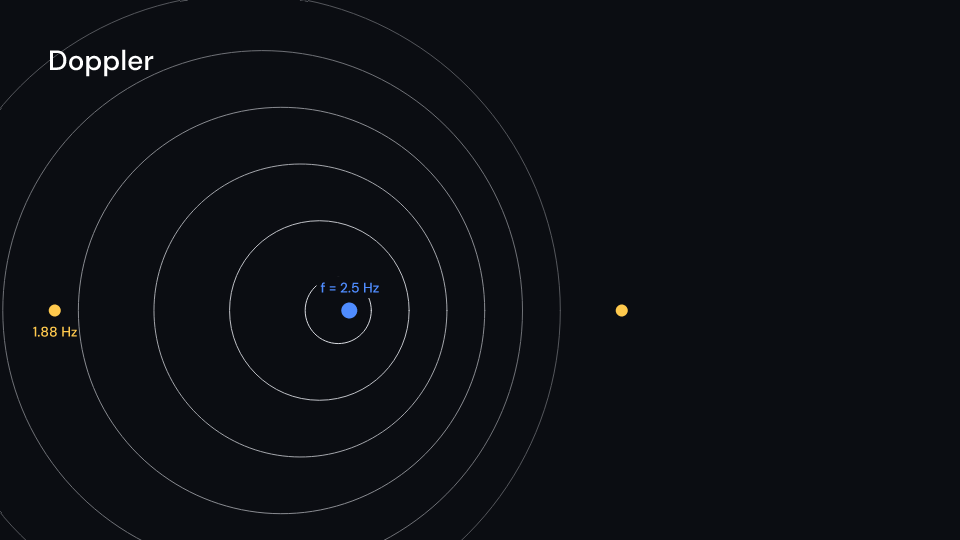
A source moving right from start at source_speed m/s sends out a front every period
seconds, and the fronts spread at wave_speed m/s. They bunch up ahead of the source and
spread out behind it. At or above the wave speed they pile into a cone. A front fades as it
grows and is gone at max_radius meters. Listeners ahead and behind (meters from
start) show the frequency they hear, f c / (c ∓ v), once the first front has reached
them. The source’s own frequency sits above it, on a chip of the background. heard and
fronts give the numbers. Gallery scene: Doppler.
Doppler 5.5 suse fframes_kit::prelude::*;
fn figure<'a>(ui: &mut Ui<'a, '_, '_>) -> Svgr<'a> { ui.show(Doppler { start: (-3.5, 0.0), scale: 0.7, source_speed: 1.0, wave_speed: 3.0, period: 0.4, ahead: Some(8.0), behind: Some(-4.0), ..ui.defaults() })}Components are plain structs. Set the fields you need and fill the rest with ..ui.defaults(): the defaults below come from the current theme (theme. values are fields of Theme).
Doppler
Section titled “Doppler”| Field | Type | Default | Description |
|---|---|---|---|
start |
(f64, f64) |
(-4.0, 0.0) |
Where the source starts, in units of ui.space; meters below are measured from it. |
scale |
f64 |
1.0 |
Units of ui.space per meter. |
source_speed |
f64 |
1.0 |
Speed of the source to the right in m/s; at or above wave_speed the fronts pile into a cone. |
wave_speed |
f64 |
3.0 |
Speed the wavefronts spread at in m/s. |
period |
f64 |
0.4 |
Seconds between two wavefronts; the source’s own frequency is its inverse. |
max_radius |
f64 |
6.0 |
Radius in meters where a front is gone; it fades out on the way. |
ahead |
Option<f64> |
Some(10.0) |
Listener in meters from start, to the right of the source; None for none. |
behind |
Option<f64> |
Some(-2.5) |
Listener in meters from start, to the left of the source; None for none. |
labels |
bool |
true |
Writes the source’s frequency above it and the frequency each listener hears once the first front reaches it. |
delay |
f32 |
0.0 |
Seconds after the container’s start before the source starts moving. |
time_scale |
f32 |
1.0 |
Speed of the motion over local time; 2 runs twice as fast, 1 is real time. |
source_color |
Color |
theme.colors.accent |
Colour of the source and its frequency label. |
wave_color |
Color |
theme.colors.text |
Colour of the wavefronts. |
listener_color |
Color |
theme.colors.highlight |
Colour of the listener marks. |
stroke_width |
f32 |
theme.stroke.thin |
Width of the wavefronts in pixels. |
enter |
Option<EnterAnim> |
None |
How the listener marks draw in; None shows them from the start. |
exit |
Option<ExitAnim> |
None |
How the listener marks leave at the end of the container; None stays. |
parts_enter |
Option<FadeIn> |
None |
How the source and the fronts fade in; None for none. |
parts_exit |
Option<FadeOut> |
None |
How the source and the fronts fade out before the end; None for none. |
Methods:
fn source(&self, t: f64) -> f64: Meters fromstart, the source aftertseconds.fn heard(&self, x: f64, t: f64) -> Option<f64>: The frequency in Hz a listener atxmeters fromstarthears while the source is where it is aftertseconds:f c / (c - v)ahead of it,f c / (c + v)behind.Noneahead of a source at or above the wave speed, where no front has come.fn fronts(&self, t: f64) -> Vec<(f64, f64)>: The emission time and the radius in meters of every front alive aftertseconds, oldest first.
Feature physics · Source