
Text components measure with the font files of the video’s media, so a layout is the same
in the editor and in the render. When a family cannot be measured (a system font, or the
editor before fonts load), each falls back to a plain <text>, as listed. text is a
Cow<str>: pass "literal".into() or format!(..).into(). style is a TextStyle from
theme.typography, and its family, size and weight are what is measured and drawn.
anchor is TextAnchor::{Start, Middle, End}.
| Component | Props | What it does | Without a font |
|---|---|---|---|
FitText |
text, x, y, style, max_width, min_size (24), step (4), fill, anchor, opacity |
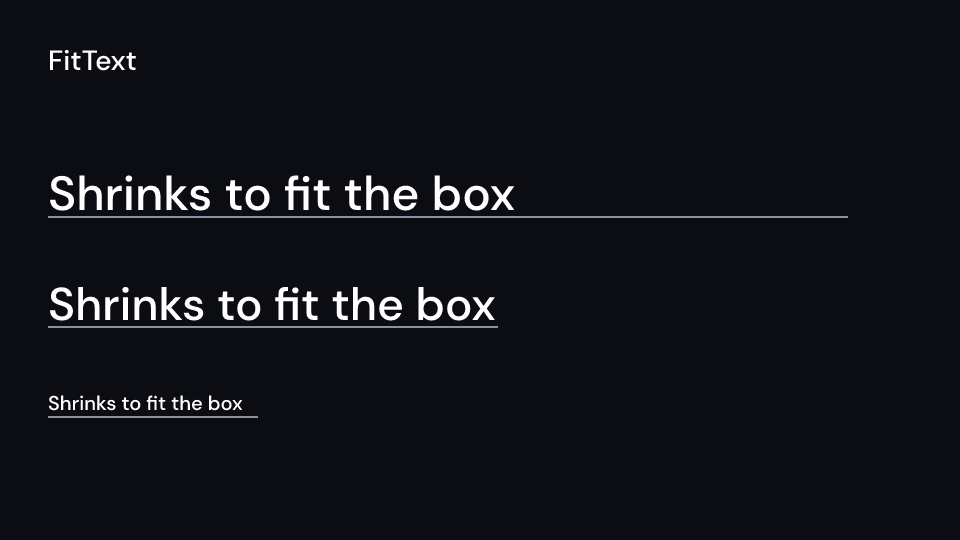
one line at the largest size up to style.size that fits max_width; fit.size(ui) gives the size |
style.size |
Letters |
text, x, y, style, fill, tracking, look: Box<dyn Fn(usize) -> LetterLook> |
each letter moved, faded and scaled about its center by look(i) (LetterLook { dx, dy, opacity, scale }) |
one line with look(0) |
TextReveal |
text, x, y, style, fill, by (RevealBy::Word, Letter), shift, delay, stagger, run_time, rate_func |
words or letters fade in one after another while they move by shift into place |
the whole line as unit 0 |
Typewriter |
text, x, y, style, fill, delay, chars_per_second (24), cursor: Option<Color>, cursor_width, blink (0.5 s) |
types one character at a time, with a cursor that blinks once the text is complete | no cursor |
Counter |
from, to, x, y, style, fill, anchor (End), decimals, thousands (true), prefix, suffix, delay, run_time, rate_func |
counts from from to to; right aligned, so the digits stay in place as the number grows |
the same |
Paragraph |
text, x, y, width, style, fill, align: TextAlign, opacity |
wraps into lines of at most width pixels, style.line_height apart; \n starts a line |
one unwrapped line |
HudLabel |
text, x, y, style (caption), fill (muted), anchor, letter_spacing (2.5), uppercase (true), opacity |
a small tracked label, like 01 / RENDER |
the same |
Title |
text, x, y, style, fill, include_underline (true), match_underline_width_to_text (false), underline_width (1720), underline_buff, underline_stroke, underline_stroke_width, opacity |
a centered title with an optional underline | fixed underline width |
Gallery scenes: Letters, TextReveal, Typewriter, Counter, Paragraph, HudLabel, Title.

Letters 2 s
TextReveal 2.5 s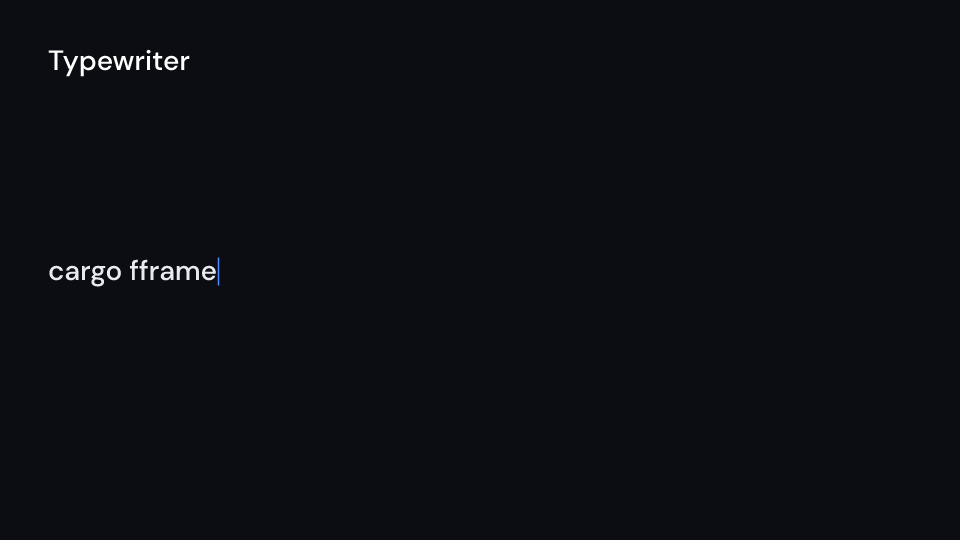
Typewriter 3 s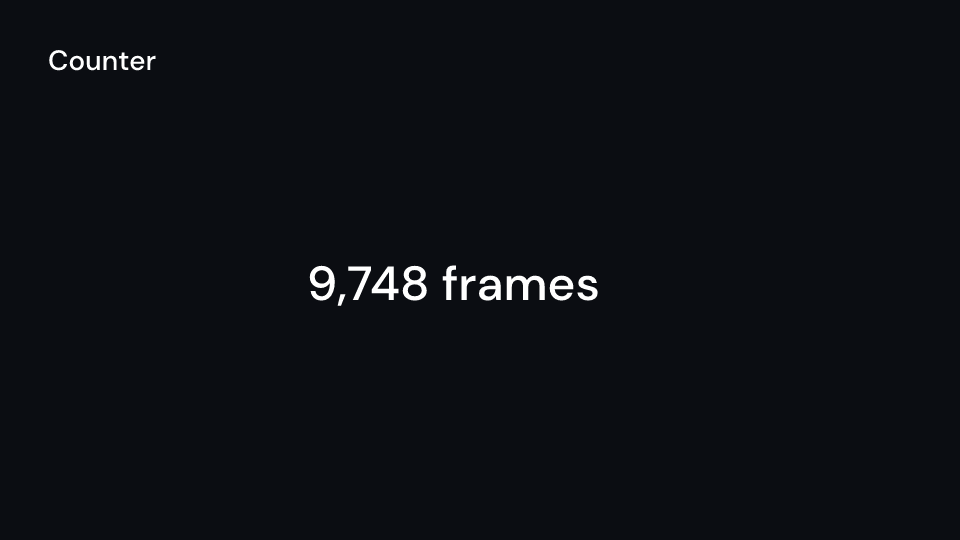
Counter 2.5 s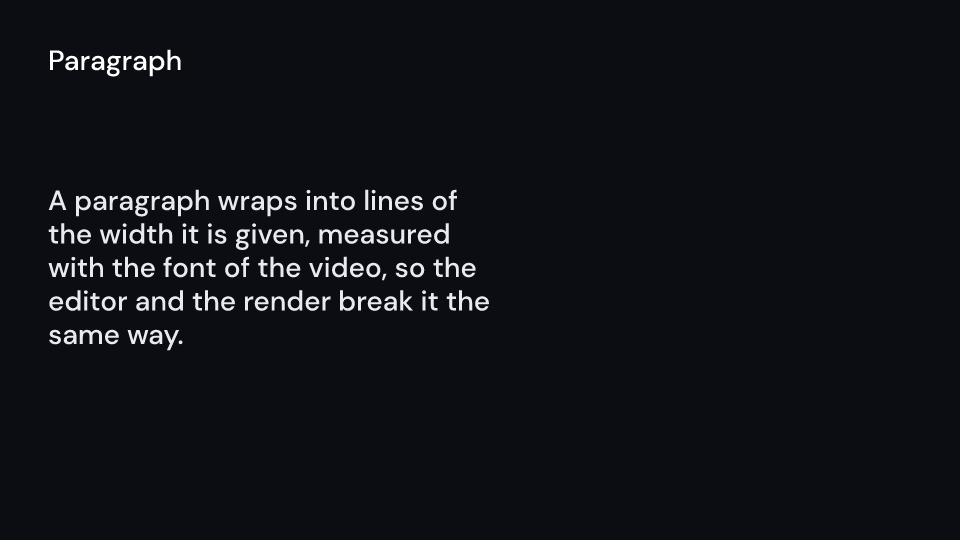
Paragraph 2 s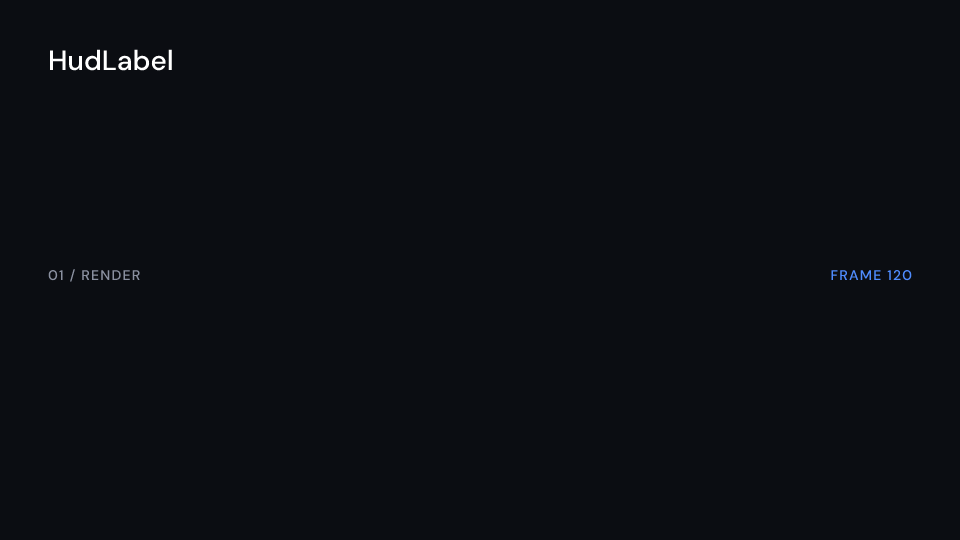
HudLabel 2 s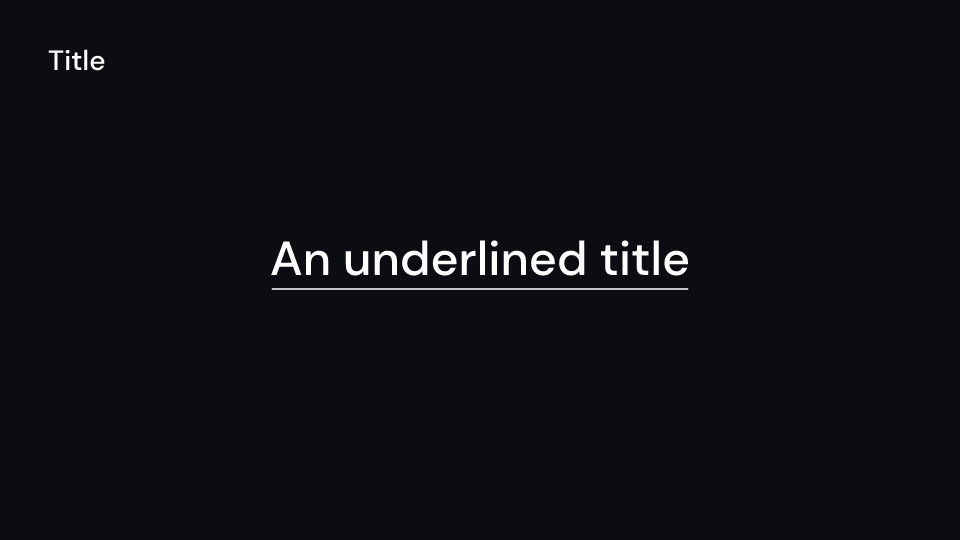
Title 2 sFit a line, type another and draw an underlined title:
use fframes_kit::prelude::*;
fn typing<'a>(ui: &mut Ui<'a, '_, '_>) -> Svgr<'a> {    let fitted = ui.show(FitText { text: "A title that fits".into(), x: 200.0, y: 300.0, max_width: 600.0, ..ui.defaults() });    let typed = ui.show(Typewriter { text: "Typed, then erased".into(), x: 200.0, y: 500.0, chars_per_second: 16.0, erase: Some(0.25), ..ui.defaults() });    let title = ui.show(Title { text: "An underlined title".into(), y: 700.0, match_underline_width_to_text: true, ..ui.defaults() });    svgr!(<g>{fitted}{typed}{title}</g>)}
Gallery scene: Label.
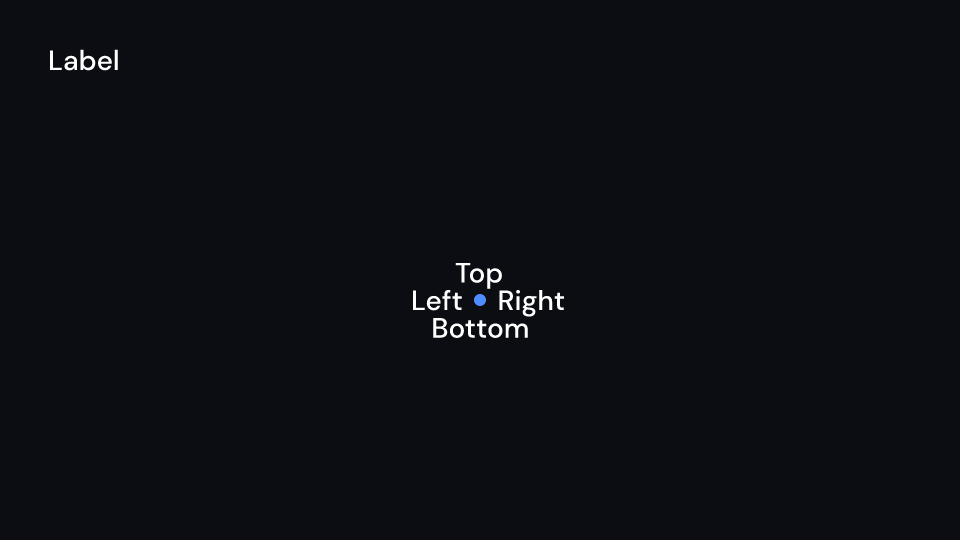
Label 2 sLabel positions text next to a point. Its direction is an Anchor, and buff is the
distance from the point in pixels.
use fframes_kit::prelude::*;
fn label<'a>(ui: &mut Ui<'a, '_, '_>) -> Svgr<'a> {    ui.show(Label {        text: "Right".into(), x: 960.0, y: 600.0,        direction: Anchor::Right, buff: 35.0, ..ui.defaults()    })}
use fframes_kit::prelude::*;
/// A stat: a label, then the number counting up under it.fn stat<'a>(ui: &mut Ui<'a, '_, '_>) -> Svgr<'a> { let label = ui.show(HudLabel { text: "frames rendered".into(), x: 96.0, y: 400.0, ..ui.defaults() }); let number = ui.show(Counter { to: 12_480.0, x: 96.0, y: 520.0, anchor: TextAnchor::Start, delay: 0.2, ..ui.defaults() }); let title = ui.show(TextReveal { text: "Twelve thousand frames".into(), x: 96.0, y: 700.0, ..ui.defaults() }); svgr!(<g>{label}{number}{title}</g>)}
let c = Counter { to: 1_000.0, decimals: 1, suffix: " ms".into(), ..Counter::default() };assert_eq!(c.format(c.value(100.0)), "1,000.0 ms");Letters takes any per-letter animation. Here each letter drops in with a spring, 60 ms
after the one before:
use fframes_kit::prelude::*;
fn drop_in<'a>(ui: &mut Ui<'a, '_, '_>) -> Svgr<'a> {    let t = ui.seconds();    ui.show(Letters {        text: "LAUNCH".into(),        x: 96.0,        y: 600.0,        look: Box::new(move |i| {            let s = motion::spring(t - motion::stagger(i, 0.06), 260.0, 18.0);            LetterLook { dy: (1.0 - s) * -120.0, opacity: motion::clamp01(s * 2.0), ..LetterLook::default() }        }),        ..ui.defaults()    })}
Fitting text into lines
Section titled “Fitting text into lines”These are Remotion’s @remotion/layout-utils text fitters, measured like the components
above. Both return None when the family cannot be measured; draw the text at style.size
then.
Gallery scene: FitText.
FitText 2 stext::fit_text_on_n_lines(ui, text, style, max_width, max_lines)givesFitLines { size, lines }: the largest size up tostyle.sizeat whichtextbreaks at spaces into at mostmax_lineslines ofmax_widthpixels. Each line is measured whole, so none is wider thanmax_width. It is alsoNonewhen a single word is wider than the box at size 1.text::fill_text_box(max_width, max_lines)is an emptyTextBox.add(ui, style, " word")puts a word on the last line, or starts a new line for it.- It returns
BoxFit { exceeds_box, new_line }. - A word that does not fit is not added.
lines()gives the lines so far.
use fframes_kit::{prelude::*, text::fit_text_on_n_lines};
/// A quote as large as it can be on three lines of 1400 pixels.fn quote<'a>(ui: &mut Ui<'a, '_, '_>, text: &'a str) -> Svgr<'a> {    let style = ui.theme.typography.title;    let Some(fit) = fit_text_on_n_lines(ui, text, style, 1400.0, 3) else {        return ui.show(Paragraph { text: text.into(), x: 260.0, y: 400.0, width: 1400.0, ..ui.defaults() });    };    let line_height = fit.size as f32 * style.line_height;    let lines: Vec<Svgr<'a>> = fit        .lines        .into_iter()        .enumerate()        .map(|(i, line)| {            let y = 400.0 + i as f32 * line_height;            svgr!(<text x="260" y={y} font-family={style.family} font-size={fit.size} font-weight={style.weight} fill="#fff">{line}</text>)        })        .collect();    svgr!(<g>{lines}</g>)}
Numbers and Manim’s text mobjects
Section titled “Numbers and Manim’s text mobjects”| Component | Props | What it does | Without a font |
|---|---|---|---|
DecimalNumber |
value: ValueTracker, x, y, style (title), fill, anchor (Start), num_decimal_places (2), include_sign, group_with_commas (true), unit, opacity |
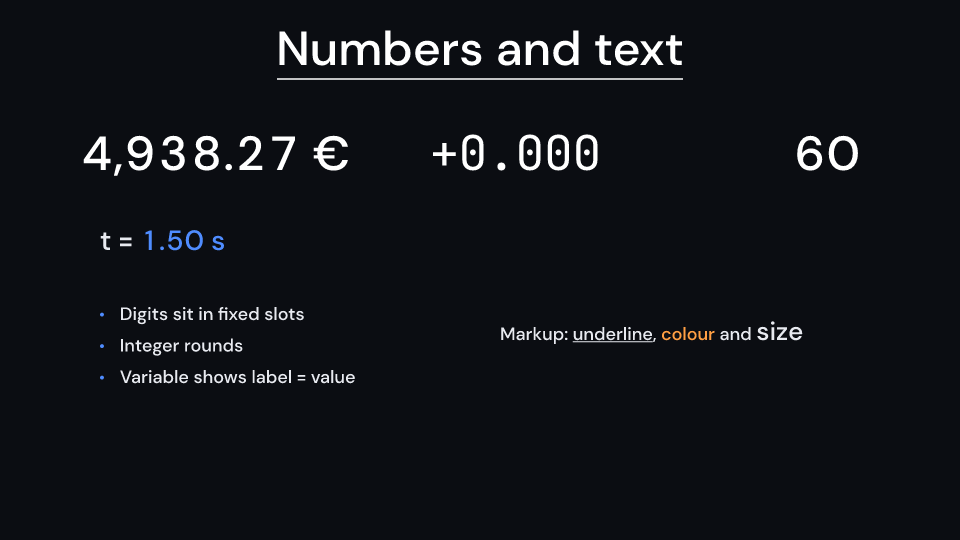
the value with every digit in a slot as wide as the widest digit, so digits do not jitter; anchor: End keeps them in place across a carry |
one line |
Integer |
as DecimalNumber without num_decimal_places |
the value rounded to a whole number | one line |
Variable |
label, value, x, y, style (heading), fill, value_fill (accent), num_decimal_places (2), unit, opacity |
label = value, the label in place and the number after it |
one line |
BulletedList |
items: Vec<Cow<str>>, x, y, style (body), fill, bullet_fill (accent), indent, line_spacing, opacity, delay (0), stagger (None), run_time (enter) |
one line per item after a round bullet (a circle, no glyph needed); baseline(i) gives a line’s y. With stagger: Some(s) item i fades and rises in from delay + i * s seconds over run_time, and revealed_at(i) gives when it is in |
the same |
Title |
text, x (960), y (130), style, fill, include_underline (true), match_underline_width_to_text, underline_width (1720), underline_buff, underline_stroke, underline_stroke_width, opacity |
a centered heading over an underline | the underline underline_width wide |
MarkupText |
markup, x, y, style (heading), fill, anchor, opacity |
one line with Pango tags: <b>, <i>, <u>, <span> with foreground, size (pixels or xx-small to xx-large), weight, style, underline |
the same |
value is a ValueTracker: a fixed number (3.5.into()), a stored timeline!
((&self.price).into()), or a value computed from time in render_frame
(f(ui.seconds()).into()), which is Manim’s always_redraw. It is an f32, exact to about
seven significant digits.
Gallery scenes: DecimalNumber, Integer, Variable, BulletedList, MarkupText.
DecimalNumber 3 s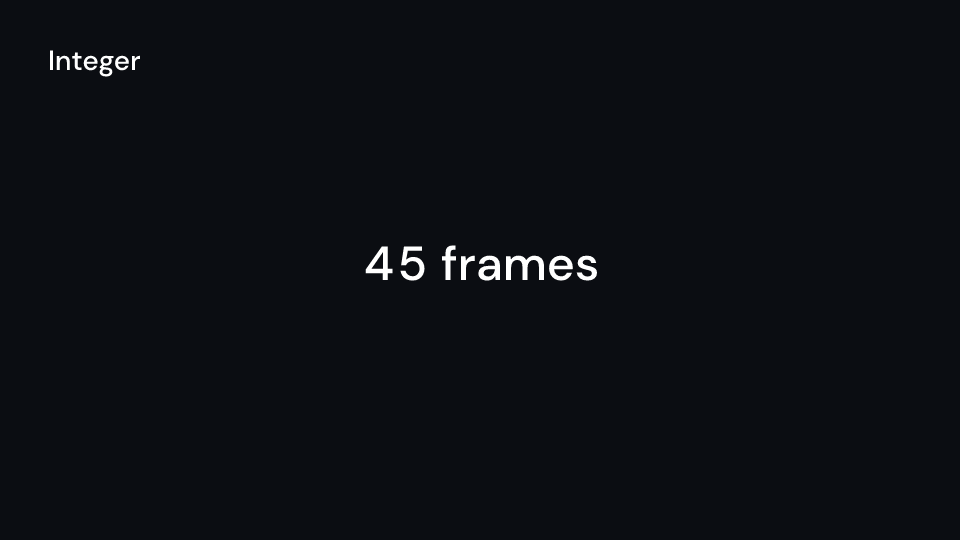
Integer 3 s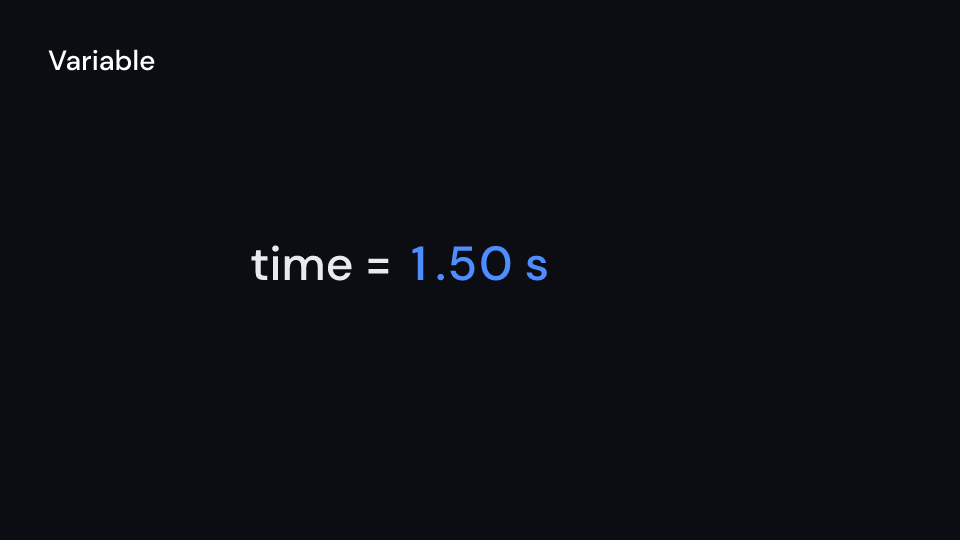
Variable 3 s
BulletedList 3 s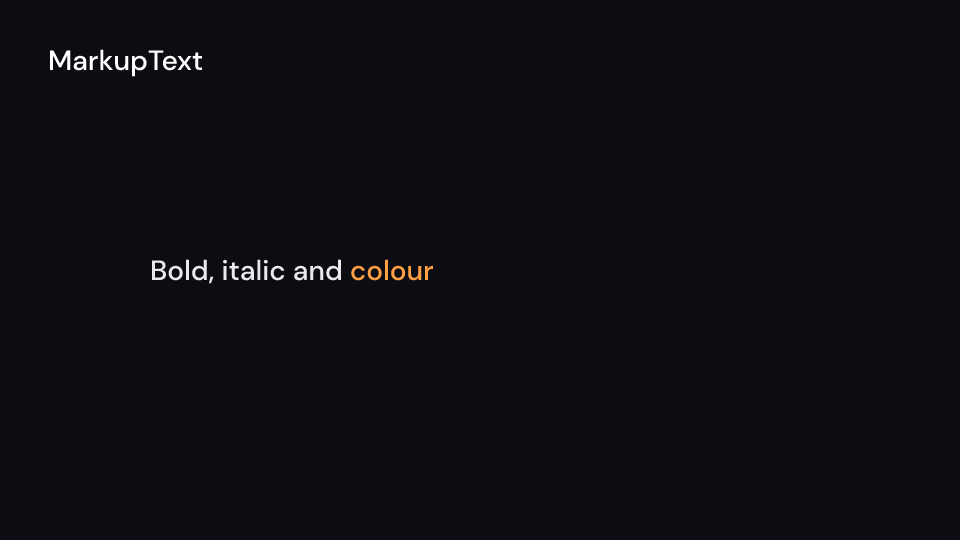
MarkupText 2 suse fframes_kit::prelude::*;
fn readout<'a>(ui: &mut Ui<'a, '_, '_>) -> Svgr<'a> { let t = ui.seconds(); let title = ui.show(Title { text: "Free fall".into(), ..ui.defaults() }); let height = ui.show(Variable { label: "h".into(), value: (100.0 - 4.905 * t * t).max(0.0).into(), x: 200.0, y: 400.0, unit: " m", ..ui.defaults() }); let steps = ui.show(BulletedList { items: vec!["drop the ball".into(), "read the height".into()], x: 200.0, y: 560.0, ..ui.defaults() }); let note = ui.show(MarkupText { markup: "<b>no</b> air <span foreground='#ff5500'>resistance</span>".into(), x: 200.0, y: 760.0, ..ui.defaults() }); svgr!(<g>{title}{height}{steps}{note}</g>)}
let n = DecimalNumber { include_sign: true, unit: " m", ..DecimalNumber::default() };assert_eq!(n.format(1234.5), "+1,234.50 m");An integer that counts frames at 30 fps and a list that reveals one item every half second:
use fframes_kit::prelude::*;
fn count<'a>(ui: &mut Ui<'a, '_, '_>) -> Svgr<'a> {    ui.show(Integer {        value: (ui.seconds() * 30.0).into(),        x: 960.0,        y: 560.0,        anchor: TextAnchor::Middle,        unit: " frames",        ..ui.defaults()    })}
fn list<'a>(ui: &mut Ui<'a, '_, '_>) -> Svgr<'a> {    ui.show(BulletedList {        items: vec!["Choose a scene".into(), "Animate its parts".into(), "Render the video".into()],        x: 300.0,        y: 400.0,        style: ui.theme.typography.heading,        delay: 0.2,        stagger: Some(0.5),        ..ui.defaults()    })}
Bold and italic in MarkupText draw with the family’s bold and italic faces, so put those
font files into the media. Unknown tags and attributes are drawn without their style, and
markup that is not well formed is drawn as plain text; inspect warns about both.
inspect --pops reports changing digits as pops “like a counter”; that is the number
counting, not a layout jump.
Components are plain structs. Set the fields you need and fill the rest with ..ui.defaults(): the defaults below come from the current theme (theme. values are fields of Theme).
FitText
Section titled “FitText”One line of text at the largest size, up to style.size, that fits into max_width pixels. It shrinks by step pixels down to min_size, where it stays even if it is still too wide. Without a measurable font it keeps style.size.
| Field | Type | Default | Description |
|---|---|---|---|
text |
Cow<str> |
Cow::Borrowed("") |
The words, on one line. |
x |
f32 |
0.0 |
The anchor point on the baseline. |
y |
f32 |
0.0 |
Baseline of the text, in pixels of the canvas. |
style |
TextStyle |
theme.typography.title |
The font: its size in pixels is the largest size tried; family and weight are kept. |
max_width |
f32 |
1600.0 |
Widest the line may be, in pixels. |
min_size |
usize |
24 |
Smallest font size in pixels it shrinks to, even if the text is still too wide. |
step |
usize |
4 |
Pixels the font size shrinks by at each try (at least 1). |
fill |
Color |
theme.colors.title |
Colour of the text. |
anchor |
TextAnchor |
TextAnchor::Start |
Which point of the text sits at x: start, middle or end. |
opacity |
f32 |
1.0 |
0 transparent to 1 opaque. |
Methods:
fn size(&self, ui: &Ui) -> usize: The font size the text is drawn at.
Letters
Section titled “Letters”A line of text drawn letter by letter, each letter with its own LetterLook from look(index). (x, y) is the start of the baseline and tracking adds pixels after every letter. Letters at opacity 0 are left out. Without a measurable font the line is one <text> with the look of letter 0.
| Field | Type | Default | Description |
|---|---|---|---|
text |
Cow<str> |
Cow::Borrowed("") |
The line of text; each character is drawn on its own. |
x |
f32 |
0.0 |
Left of the first letter, in pixels of the canvas. |
y |
f32 |
0.0 |
Baseline of the text, in pixels of the canvas. |
style |
TextStyle |
theme.typography.title |
The font: family, size in pixels and weight. |
fill |
Color |
theme.colors.title |
Colour of the letters. |
tracking |
f32 |
0.0 |
Extra pixels after every letter. |
look |
Box<dyn Fn(usize) -> LetterLook> |
Box::new(|_| LetterLook::default()) |
Gives the LetterLook of letter index, counting from 0; letters at opacity 0 are not drawn. |
TextReveal
Section titled “TextReveal”A line whose words or letters fade in one after another while they move by shift into place. Unit i starts delay + i * stagger seconds into the container and takes run_time. (x, y) is the start of the baseline. Without a measurable font the whole line fades in as unit 0.
| Field | Type | Default | Description |
|---|---|---|---|
text |
Cow<str> |
Cow::Borrowed("") |
The words or letters that fade in; the whole line is drawn as one when the font cannot be measured. |
x |
f32 |
0.0 |
Left of the line, in pixels of the canvas. |
y |
f32 |
0.0 |
Baseline of the text, in pixels of the canvas. |
style |
TextStyle |
theme.typography.title |
The font: family, size in pixels and weight. |
fill |
Color |
theme.colors.title |
Colour of the text. |
by |
RevealBy |
RevealBy::Word |
Whether it reveals word by word or letter by letter. |
shift |
(f32, f32) |
(0.0, 24.0) |
Canvas units, y down: (0.0, 24.0) rises 24 units into place. |
delay |
f32 |
0.0 |
Seconds after the container’s start before the first unit begins. |
stagger |
f32 |
theme.motion.stagger.tight |
Seconds between the starts of two units. |
run_time |
f32 |
theme.motion.duration.enter |
Seconds each unit takes to fade and move into place. |
rate_func |
RateFunc |
theme.motion.easing.enter |
Easing of each unit over its run time. |
Typewriter
Section titled “Typewriter”Types its text one character at a time, chars_per_second from delay seconds into the container, with a cursor after the last character (Manim’s TypeWithCursor). The cursor is steady while typing and blinks every blink seconds once the text is complete. With erase it deletes the text again at the same rate, from the end, finishing erase seconds before the end of the container (Manim’s UntypeWithCursor). (x, y) is the start of the baseline. Without a measurable font there is no cursor.
| Field | Type | Default | Description |
|---|---|---|---|
text |
Cow<str> |
Cow::Borrowed("") |
The words that are typed. |
x |
f32 |
0.0 |
Left of the text, in pixels of the canvas. |
y |
f32 |
0.0 |
Baseline of the text, in pixels of the canvas. |
style |
TextStyle |
theme.typography.body |
The font: family, size in pixels and weight. |
fill |
Color |
theme.colors.text |
Colour of the text. |
delay |
f32 |
0.0 |
Seconds after the container’s start before typing begins. |
chars_per_second |
f32 |
24.0 |
Characters typed (and erased) per second. |
cursor |
Option<Color> |
Some(theme.colors.accent) |
None draws no cursor. |
cursor_width |
f32 |
3.0 |
Cursor width in pixels; its height is the font size. |
blink |
f32 |
0.5 |
Seconds the cursor is on, then off, after typing; 0 keeps it on. |
erase |
Option<f32> |
None |
Seconds before the end of the container when the erasing is done; None keeps the text. |
Methods:
fn typed(&self, t: f32) -> usize: Characters typedtseconds into the container.fn shown(&self, t: f32, end: Option<f32>) -> usize: Characters showntseconds into a container that ends atendseconds: typed, less the erased ones.fn cursor_on(&self, t: f32) -> bool: Whether the cursor showstseconds into the container; it is steady while erasing.fn cursor_on_until(&self, t: f32, end: Option<f32>) -> bool:cursor_onin a container that ends atendseconds.
Counter
Section titled “Counter”A number that counts from from to to over run_time seconds, starting delay seconds into the container: "0" -> "12,480". It is right aligned by default, so the digits stay in place while the number grows.
| Field | Type | Default | Description |
|---|---|---|---|
from |
f64 |
0.0 |
The value shown before delay. |
to |
f64 |
0.0 |
The value reached after run_time. |
x |
f32 |
0.0 |
Position of the number’s anchor, in pixels of the canvas. |
y |
f32 |
0.0 |
Baseline of the text, in pixels of the canvas. |
style |
TextStyle |
theme.typography.title |
The font: family, size in pixels and weight. |
fill |
Color |
theme.colors.title |
Colour of the text. |
anchor |
TextAnchor |
TextAnchor::End |
Which point of the text sits at x: start, middle or end. |
decimals |
usize |
0 |
Digits after the decimal point. |
thousands |
bool |
true |
Groups the digits by three with commas. |
prefix |
Cow<str> |
Cow::Borrowed("") |
Text written before the number, such as a currency sign; empty for none. |
suffix |
Cow<str> |
Cow::Borrowed("") |
Text written after the number, such as a unit; empty for none. |
delay |
f32 |
0.0 |
Seconds after the container’s start before it begins to count. |
run_time |
f32 |
theme.motion.duration.slow * 2.0 |
Seconds the count takes. |
rate_func |
RateFunc |
theme.motion.easing.standard |
Easing of the count over its run time. |
Methods:
fn value(&self, t: f32) -> f64: The valuetseconds into the container.fn format(&self, value: f64) -> String: The text shown forvalue.
Paragraph
Section titled “Paragraph”Text wrapped into lines of at most width pixels (Frame::text_break_lines), aligned inside that width. (x, y) is the start of the first baseline; lines are style.line_height apart and \n starts a new one. Without a measurable font it is one unwrapped line.
| Field | Type | Default | Description |
|---|---|---|---|
text |
Cow<str> |
Cow::Borrowed("") |
The words; \n starts a new line. |
x |
f32 |
0.0 |
Left edge of the wrap box in pixels of the canvas. |
y |
f32 |
0.0 |
Baseline of the first line in pixels of the canvas; later lines go below by the line height. |
width |
f32 |
800.0 |
Width in pixels the text wraps into; lines are aligned inside it. |
style |
TextStyle |
theme.typography.body |
The font: family, size in pixels, weight and line height. |
fill |
Color |
theme.colors.text |
Colour of the text. |
align |
TextAlign |
TextAlign::Left |
How the lines sit inside width: left, center or right. |
opacity |
f32 |
1.0 |
0 transparent to 1 opaque. |
HudLabel
Section titled “HudLabel”A small tracked label, like the annotations of an engineering drawing (“01 / RENDER”). uppercase turns the text to capitals.
| Field | Type | Default | Description |
|---|---|---|---|
text |
Cow<str> |
Cow::Borrowed("") |
The words; shown in capitals when uppercase is set. |
x |
f32 |
0.0 |
Position of the text’s anchor point, in pixels of the canvas. |
y |
f32 |
0.0 |
Baseline of the text, in pixels of the canvas. |
style |
TextStyle |
theme.typography.caption |
The font: family, size in pixels and weight. |
fill |
Color |
theme.colors.muted |
Colour of the text. |
anchor |
TextAnchor |
TextAnchor::Start |
Which point of the text sits at x: start, middle or end. |
letter_spacing |
f32 |
2.5 |
Pixels between letters. |
uppercase |
bool |
true |
true writes the text in capitals. |
opacity |
f32 |
1.0 |
0 transparent to 1 opaque. |
Methods:
fn draw(self) -> Svgr: The label as a<text>element; it needs noUi, so it can be drawn anywhere.
Manim’s Title: a line of text centered on x near the top, over an underline underline_width wide, or as wide as the text with match_underline_width_to_text (and a measurable font).
| Field | Type | Default | Description |
|---|---|---|---|
text |
Cow<str> |
Cow::Borrowed("") |
The title words. |
x |
f32 |
960.0 |
Horizontal center of the title and its underline, in pixels of the canvas. |
y |
f32 |
130.0 |
The baseline. |
style |
TextStyle |
theme.typography.title |
The font: family, size in pixels and weight. |
fill |
Color |
theme.colors.title |
Colour of the text. |
include_underline |
bool |
true |
true draws a line under the text. |
match_underline_width_to_text |
bool |
false |
true makes the underline as wide as the text instead of underline_width (when the font can be measured). |
underline_width |
f32 |
1720.0 |
Width of the underline in pixels. |
underline_buff |
f32 |
28.0 |
Pixels from the baseline down to the underline. |
underline_stroke |
Color |
theme.colors.title |
Colour of the underline. |
underline_stroke_width |
f32 |
3.0 |
Thickness of the underline in pixels. |
opacity |
f32 |
1.0 |
0 transparent to 1 opaque. |
One line of text whose box sits buff pixels from (x, y) in direction: Top puts it above the point, TopRight up and to the right, Center on it.
| Field | Type | Default | Description |
|---|---|---|---|
text |
Cow<str> |
Cow::Borrowed("") |
The text, one line. |
x |
f32 |
0.0 |
X in pixels of the canvas of the point the text sits next to. |
y |
f32 |
0.0 |
Y in pixels of the canvas of the point the text sits next to (y down). |
direction |
Anchor |
Anchor::Right |
Which side of the point the text box sits on (Top above it, TopRight up and right, Center on it). |
buff |
f32 |
theme.spacing.sm |
Pixels between the point and the text’s box. |
style |
TextStyle |
theme.typography.body |
The font: family, size in pixels and weight. |
fill |
Color |
theme.colors.title |
Colour of the text. |
enter |
Option<FadeIn> |
None |
Fade in at the start; None for none. |
exit |
Option<FadeOut> |
None |
Fade out before the end; None for none. |
Methods:
fn size(&self, ui: &Ui) -> (f32, f32): Width and height of the text’s box, seetext_size.fn bounds(&self, ui: &Ui) -> Rect: The box the text is drawn in, in pixels.
DecimalNumber
Section titled “DecimalNumber”Manim’s DecimalNumber: a number that follows a ValueTracker, drawn so its digits do not jitter while it changes. Every digit gets a slot as wide as the widest digit of the font, so a number keeps its width while its digit count stays the same, and with anchor: End the digits stay in place across a carry (9.99 -> 10.00). The value is an f32, exact to about seven significant digits.
| Field | Type | Default | Description |
|---|---|---|---|
value |
ValueTracker |
0.0.into() |
The ValueTracker whose value is written; it is read at every frame. |
x |
f32 |
0.0 |
Position of the number’s anchor, in pixels of the canvas. |
y |
f32 |
0.0 |
Baseline of the text, in pixels of the canvas. |
style |
TextStyle |
theme.typography.title |
The font: family, size in pixels and weight. |
fill |
Color |
theme.colors.title |
Colour of the text. |
anchor |
TextAnchor |
TextAnchor::Start |
Which point of the number (with its unit) sits at x: start, middle or end. |
num_decimal_places |
usize |
2 |
Digits after the decimal point. |
include_sign |
bool |
false |
A + before positive numbers. |
group_with_commas |
bool |
true |
true groups the digits by three with commas. |
unit |
&str |
"" |
Text written after the number, such as " kg"; empty for none. |
opacity |
f32 |
1.0 |
0 transparent to 1 opaque. |
Methods:
fn format(&self, value: f64) -> String: The text shown forvalue, with the unit.
Integer
Section titled “Integer”Manim’s Integer: a DecimalNumber without decimals, rounded to the nearest whole number.
| Field | Type | Default | Description |
|---|---|---|---|
value |
ValueTracker |
d.value |
The ValueTracker whose value is written; it is read at every frame. |
x |
f32 |
d.x |
Position of the number’s anchor, in pixels of the canvas. |
y |
f32 |
d.y |
Baseline of the text, in pixels of the canvas. |
style |
TextStyle |
d.style |
The font: family, size in pixels and weight. |
fill |
Color |
d.fill |
Colour of the text. |
anchor |
TextAnchor |
d.anchor |
Which point of the number (with its unit) sits at x: start, middle or end. |
include_sign |
bool |
d.include_sign |
true writes a + before positive numbers. |
group_with_commas |
bool |
d.group_with_commas |
true groups the digits by three with commas. |
unit |
&str |
d.unit |
Text written after the number, such as " kg"; empty for none. |
opacity |
f32 |
d.opacity |
0 transparent to 1 opaque. |
Variable
Section titled “Variable”Manim’s Variable: label = value, the value a DecimalNumber that follows a ValueTracker. (x, y) is the start of the label on the baseline; the label stays in place and the number grows to the right. For a value computed from time, pass value: f(ui.seconds()).into() in render_frame, which runs every frame.
| Field | Type | Default | Description |
|---|---|---|---|
label |
Cow<str> |
Cow::Borrowed("") |
The name written before the =. |
value |
ValueTracker |
0.0.into() |
The ValueTracker whose value is written; it is read at every frame. |
x |
f32 |
0.0 |
Left of the label, in pixels of the canvas; the number follows it. |
y |
f32 |
0.0 |
Baseline of the text, in pixels of the canvas. |
style |
TextStyle |
theme.typography.heading |
The font: family, size in pixels and weight. |
fill |
Color |
theme.colors.text |
Colour of the label and the =. |
value_fill |
Color |
theme.colors.accent |
The color of the number; the label and = take fill. |
num_decimal_places |
usize |
2 |
Digits after the decimal point. |
unit |
&str |
"" |
Text written after the number, such as " kg"; empty for none. |
opacity |
f32 |
1.0 |
0 transparent to 1 opaque. |
BulletedList
Section titled “BulletedList”Manim’s BulletedList: one line per item, each after a round bullet. (x, y) is the left of the first bullet on the first baseline; lines are line_spacing times the font size apart. The bullets are circles, so they need no glyph in the font.
| Field | Type | Default | Description |
|---|---|---|---|
items |
Vec<Cow<str>> |
Vec::new() |
One line per item, each after a bullet. |
x |
f32 |
0.0 |
Left of the first bullet, in pixels of the canvas. |
y |
f32 |
0.0 |
Baseline of the first item, in pixels of the canvas. |
style |
TextStyle |
style |
The font: family, size in pixels and weight. |
fill |
Color |
theme.colors.text |
Colour of the text. |
bullet_fill |
Color |
theme.colors.accent |
Colour of the bullets. |
indent |
f32 |
style.size as f32 * 1.1 |
Pixels from the bullet’s left to the text. |
line_spacing |
f32 |
style.line_height * 1.25 |
Baseline distance as a multiple of the font size. |
opacity |
f32 |
1.0 |
0 transparent to 1 opaque. |
delay |
f32 |
0.0 |
Seconds before the first item comes in, when stagger is set. |
stagger |
Option<f32> |
None |
Seconds between the starts of two items coming in; None (the default) shows every item from the start. |
run_time |
f32 |
theme.motion.duration.enter |
Seconds each item takes to fade and rise into place, when stagger is set. |
Methods:
fn baseline(&self, index: usize) -> f32: The baseline of itemindex.fn revealed_at(&self, index: usize) -> f32: Seconds into the container when itemindexis fully in: 0 without astagger.
MarkupText
Section titled “MarkupText”Manim’s MarkupText: one line with Pango-style tags, "a <b>bold</b> <span foreground='#ff5500'>word</span>".
| Field | Type | Default | Description |
|---|---|---|---|
markup |
Cow<str> |
Cow::Borrowed("") |
The text with Pango-style tags: <b>, <i>, <u> and <span>. |
x |
f32 |
0.0 |
Position of the text’s anchor point, in pixels of the canvas. |
y |
f32 |
0.0 |
Baseline of the text, in pixels of the canvas. |
style |
TextStyle |
theme.typography.heading |
The font: family, size in pixels and weight. |
fill |
Color |
theme.colors.text |
Colour of the text outside any <span> colour. |
anchor |
TextAnchor |
TextAnchor::Start |
Which point of the text sits at x: start, middle or end. |
opacity |
f32 |
1.0 |
0 transparent to 1 opaque. |