
Overlays sit on top of a scene: who is speaking, what is said, where in the video we are.
They take their times from the container they are shown in (ui.seconds() and
ui.duration), so the same lower third works in any scene or Sequence, and the ones
that leave do so before the container ends.
| Component | Props | What it does |
|---|---|---|
Appear |
Appear::new(ui, from, center, children), then until, rise (60), scale_from (0.92), enter, exit, rate_func |
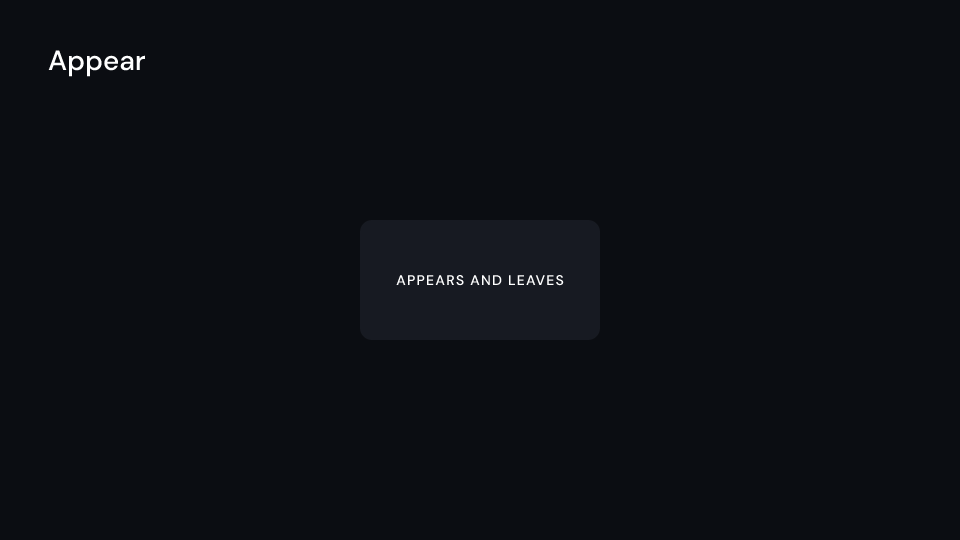
children rise, grow about center and fade in at from seconds, and leave upward at until (or the end of the container); inside, time starts at from |
LowerThird |
name, role, x, y, name_style, role_style, name_fill, role_fill, bar, bar_width (6), background: Option<Color>, min_width, padding, delay, stagger, run_time, exit, rate_func |
an accent bar grows, then the name and the role slide out from behind it; all of it leaves in reverse order before the end. With background, a plate as wide as the longer line |
Captions |
file, x, y, width, style, fill, align, video_time (true) |
the cue of a WebVTT file that plays now, wrapped into width; cue times are video seconds, or container seconds with video_time: false |
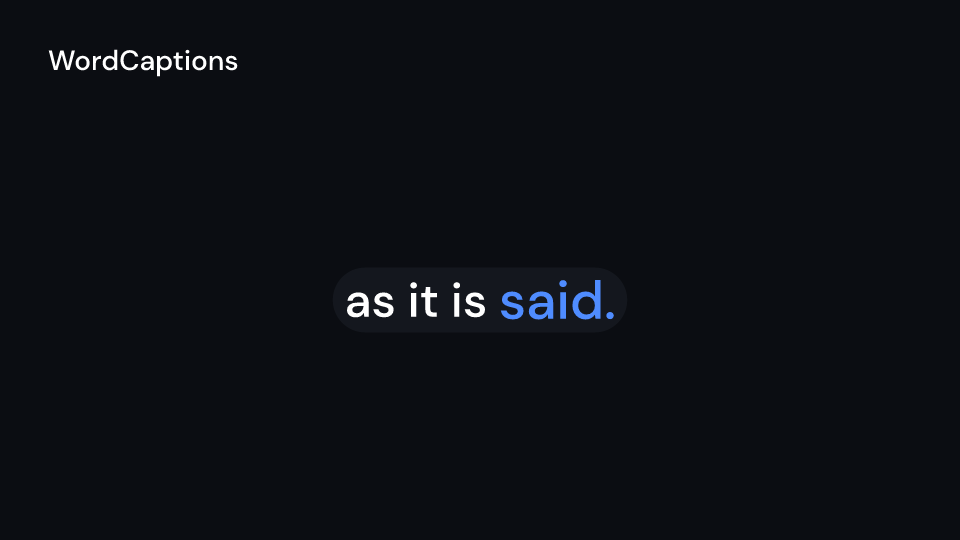
WordCaptions |
pages: Vec<TikTokPage>, x, y, width, max_lines (2), style (title), fill, highlight (accent), pop (1.12), fade (0.08 s), uppercase, pill: Option<Color>, pill_opacity, padding, entrance (PageEntrance::Pop, Fade, Rise, None), enter, exit |
TikTok-style captions: the page that plays now, centred on (x, y), the word being said in highlight and grown by pop, its neighbours moved aside; a page that needs more than max_lines lines shrinks. Times are milliseconds of the container |
CaptionStack |
items: Vec<Caption> (Caption::new(at, tag, line)), x, y, gap, tag_style, line_style, tag_fill, line_fill, tag_spacing, rise, enter, leave, rate_func |
timed captions without a file: each rises in at its at and leaves upward while the next comes in; the last stays |
ChapterList |
chapters: Vec<(f32, Cow<str>)>, x, y, width, row_height, gap, style, fill, active_fill, highlight, radius, spring |
an agenda whose highlight springs to the chapter playing now |
Annotation |
target, label, text, color, style, letter_spacing, stroke_width, delay, run_time, rate_func |
a dot on target, an elbow line to label and the text at its end; the line draws on, the text fades in |
ProgressBar |
x, y, width, height (8), radius, track, fill, progress: Option<f32> |
how far the container is (None), or a given value from 0 to 1 |
Check |
x, y, size, color, stroke_width (5), delay, run_time, rate_func |
a check mark that draws itself on |
Gallery scenes: Appear, LowerThird, Captions, CaptionStack, ChapterList,
Annotation, ProgressBar, Check.
Appear 2.5 s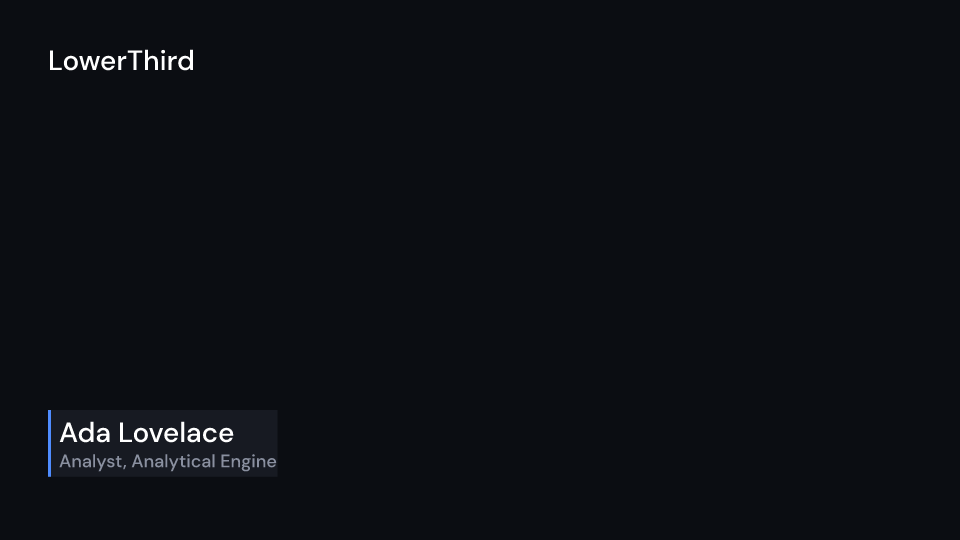
LowerThird 3 s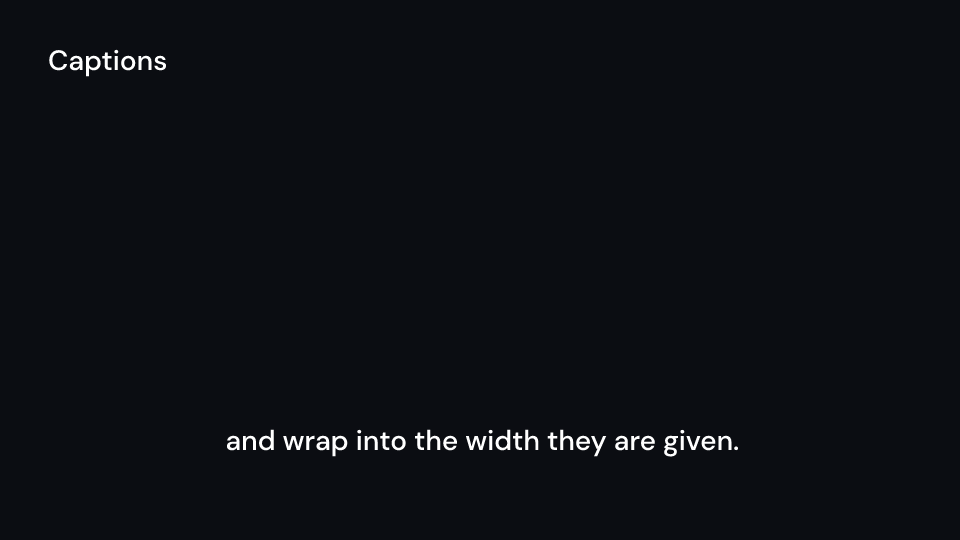
Captions 3 s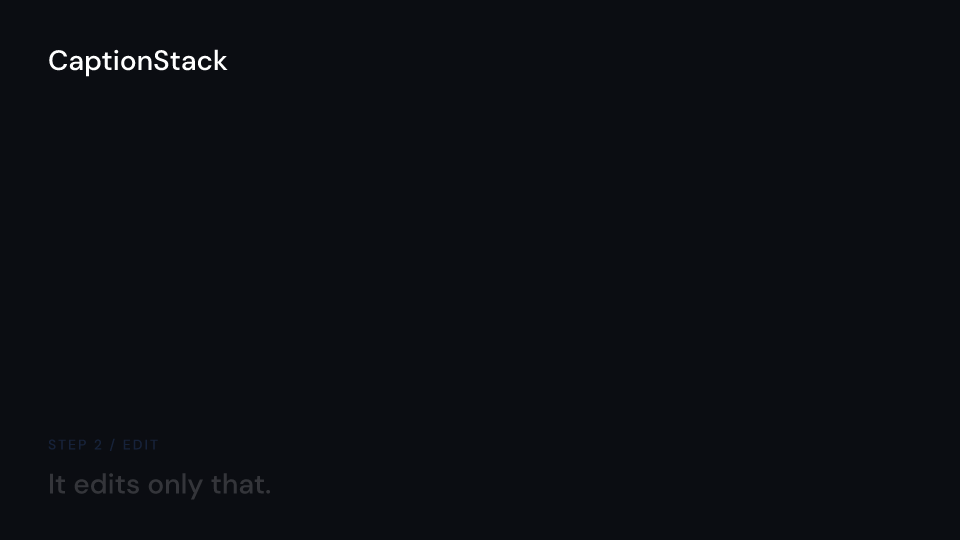
CaptionStack 3 s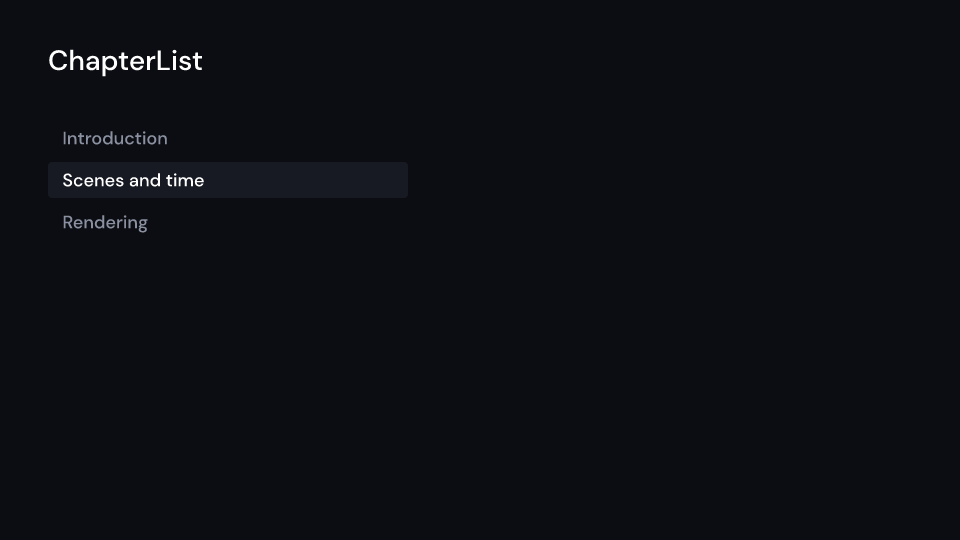
ChapterList 3 s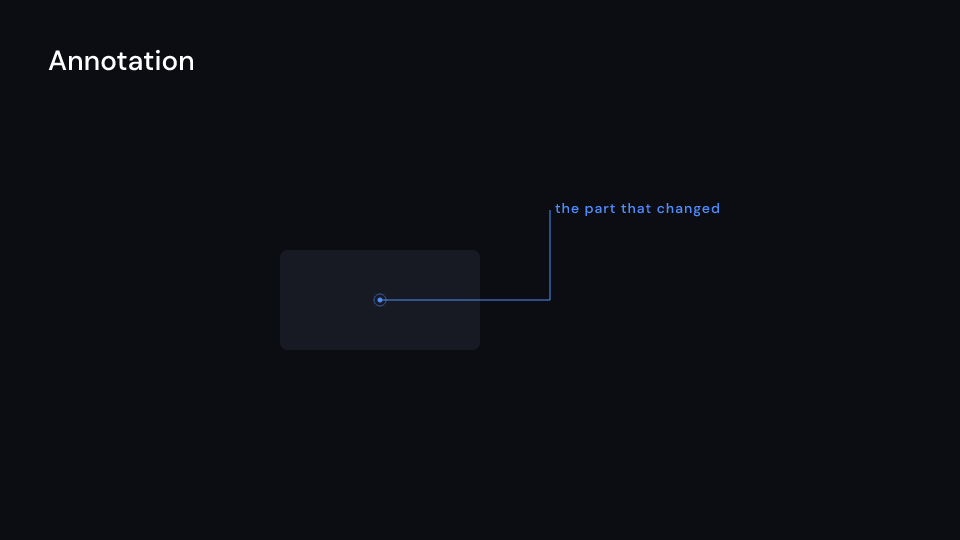
Annotation 2 s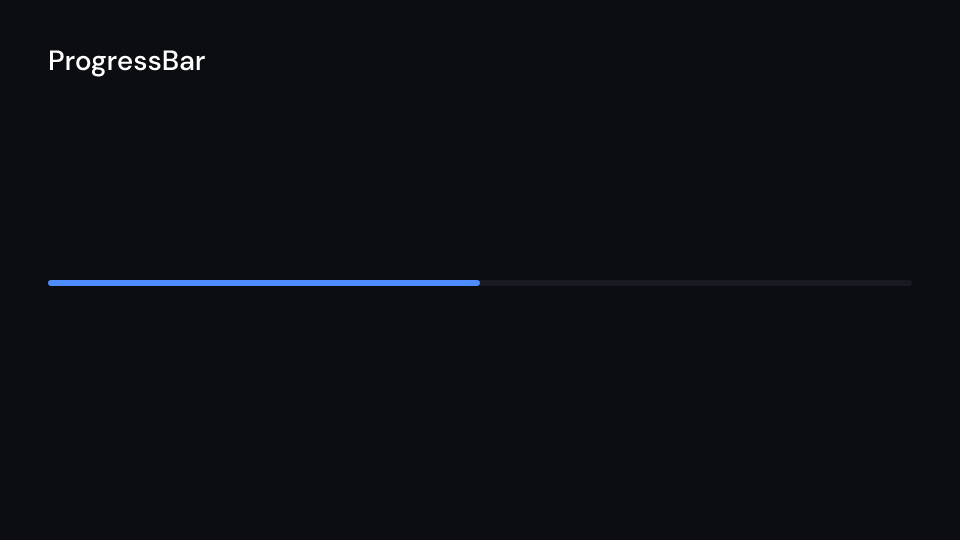
ProgressBar 2 s
Check 2 sAnnotation is the HUD callout with a line; Callout (under Shapes) is the speech bubble.
Captions has no glow of its own: wrap it in a <g filter=..> with the Glow decoration.
use fframes_kit::prelude::*;
fn annotations<'a>(ui: &mut Ui<'a, '_, '_>) -> Svgr<'a> {    let appear = Appear::new(ui, 0.5, (960.0, 540.0), children(|ui| {        ui.show(Check { x: 960.0, y: 540.0, size: 80.0, ..ui.defaults() })    }));    let appear = ui.show(appear);    let note = ui.show(Annotation { target: (960.0, 540.0), label: (1200.0, 400.0), text: "Ready".into(), ..ui.defaults() });    let captions = ui.show(CaptionStack {        items: vec![Caption::new(0.0, "01", "First"), Caption::new(2.0, "02", "Next")],        x: 200.0, y: 800.0, ..ui.defaults()    });    svgr!(<g>{appear}{note}{captions}</g>)}
A speaker introduced over the first four seconds of a scene, with captions from a file under it and the video’s progress at the bottom:
use fframes_kit::prelude::*;
fn speaker<'a>(ui: &mut Ui<'a, '_, '_>) -> Svgr<'a> {    let intro = Sequence { from: 0.5, duration: Some(4.0), children: children(|ui| {        ui.show(LowerThird { name: "Ada Lovelace".into(), role: "Analyst".into(), ..ui.defaults() })    }) };    let intro = ui.show(intro);    let captions = ui.show(Captions { file: "talk.vtt", y: 980.0, ..ui.defaults() });    let progress = ui.show(ProgressBar { y: 1064.0, height: 4.0, ..ui.defaults() });    svgr!(<g>{intro}{captions}{progress}</g>)}
let list = ChapterList {    chapters: vec![(0.0, "Intro".into()), (5.0, "Demo".into())],    ..ChapterList::default()};assert_eq!(list.active(6.0), 1);
Word captions and voiceover timing
Section titled “Word captions and voiceover timing”Word timings are data you bring. Nothing here speaks, records or recognises speech.
- Caption files.
CaptionWord { text, start_ms, end_ms, timestamp_ms, confidence }is Remotion’sCaption.text::parse_srtandtext::parse_vttread the cues of a subtitle file: oneCaptionWordeach, trimmed, with confidence 1.text::serialize_srt(&lines)writes one cue per line of words.text::from_whisper_jsonreads the words of openai-whisper (segments[].words[]orwords[], in seconds) and of whisper.cpp (transcription[]withoffsetsin milliseconds; run it with-ml 1for one word per entry). Transcript words keep their leading space:" world".
- Pages.
overlay::tiktok_pages(&words, combine_within_ms)iscreateTikTokStyleCaptions. A word that starts with a space starts a new page once the page has run forcombine_within_ms. Subtitle cues have no leading space, so their pages break only between voiceover blocks. - Voiceover.
VoiceoverScriptis manim-voiceover’s timing.- A block is
VoiceoverBlock::new(text, audio, words): a recorded file and its words. <bookmark mark="A"/>in the text marks a moment. It is timed at the first word after it, counted in letters, so a transcript that splits words differently still lines up.VoiceoverScript::in_sequence(blocks, start, gap)plays the blocks one after the other;VoiceoverScript::newplays them at their ownstart.- It gives:
block(i): start, duration and end;bookmark("A"),time_until_bookmark("A", t)andremaining(i, t);subcaptions(): the words in container time, fortiktok_pages;audio_tracks(), forfn audio;sequence(i, children): aSequenceas long as the block. For aSeries, give an itemblock(i).duration.
- A block is
Times are seconds of the container the script is used in (milliseconds for the words). Give
the video’s fn audio the tracks of a script that runs on video time. Gallery scenes:
WordCaptions and Voiceover.
WordCaptions 3.5 s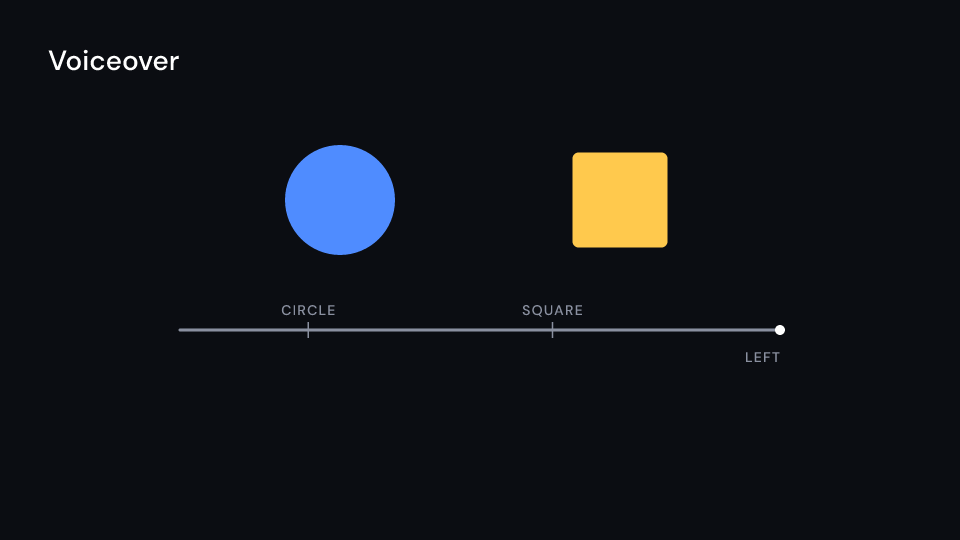
Voiceover 3.5 suse fframes_kit::{overlay::tiktok_pages, prelude::*, text::from_whisper_json};
/// Narration with a dot that appears at its bookmark and the words under it.struct Narrated { script: VoiceoverScript<'static>, pages: Vec<TikTokPage>,}
impl Narrated { fn new(transcript: &str) -> Self { let words = from_whisper_json(transcript).unwrap_or_default(); let block = VoiceoverBlock::new("Here is <bookmark mark=\"dot\"/>a dot.", "voice.wav", words); let script = VoiceoverScript::in_sequence(vec![block], 0.5, 0.0); let pages = tiktok_pages(&script.subcaptions(), 1200.0); Self { script, pages } }
fn draw<'a>(&self, ui: &mut Ui<'a, '_, '_>) -> Svgr<'a> { let at = self.script.bookmark("dot").unwrap_or(0.0); let opacity = motion::progress(ui.seconds(), at, at + 0.3); let captions = ui.show(WordCaptions { pages: self.pages.clone(), ..ui.defaults() }); svgr!(<g><circle cx="960" cy="480" r="80" fill="#4f8cff" opacity={opacity} />{captions}</g>) }
fn audio(&self) -> AudioMap<'static> { AudioMap::from(self.script.audio_tracks()) }}
let narrated = Narrated::new( r#"{"words": [{"word": " Here", "start": 0.0, "end": 0.3}, {"word": " is", "start": 0.3, "end": 0.45}, {"word": " a", "start": 0.6, "end": 0.7}, {"word": " dot.", "start": 0.7, "end": 1.1}]}"#,);assert_eq!(narrated.script.bookmark("dot"), Some(1.1));assert_eq!(narrated.pages.len(), 1);let _ = narrated.audio();Components are plain structs. Set the fields you need and fill the rest with ..ui.defaults(): the defaults below come from the current theme (theme. values are fields of Theme).
Appear
Section titled “Appear”Shows its children from from seconds on: they rise rise units into place, grow from scale_from about center and fade in over enter seconds. They leave the same way up over exit seconds, ending at until seconds, or at the end of the container (ui.duration) when until is None. Inside, time starts at from, as in a Sequence.
| Field | Type | Default | Description |
|---|---|---|---|
from |
f32 |
— | Seconds after the container’s start when the children appear; inside, their time starts at from. |
until |
Option<f32> |
— | Seconds when the children are gone, after leaving over exit; None ends with the container. |
center |
(f32, f32) |
— | The point the content scales about, in canvas units. |
rise |
f32 |
— | Pixels the children rise into place as they enter, and sink as they leave. |
scale_from |
f32 |
— | Scale the children grow from as they enter, 1 for no growth. |
enter |
f32 |
— | Seconds the children take to fade, rise and grow in. |
exit |
f32 |
— | Seconds the children take to leave before until or the end of the container; 0 cuts them off. |
rate_func |
RateFunc |
— | Easing of the entrance over enter seconds. |
children |
Children |
— | What it shows (a closure taking the Ui). |
Methods:
fn new(ui: &Ui, from: f32, center: (f32, f32), children: Children) -> Self: Times and motion from the theme:motion.duration.enterandexit, a 60 unit rise, scaling from 0.92.fn state(&self, t: f32, end: Option<f32>) -> (f32, f32):(entered, left), both from 0 to 1, attseconds of a container that ends atend.
LowerThird
Section titled “LowerThird”A name and a role next to an accent bar, the caption of a speaker. The bar grows first, then the name and the role slide in from behind it, stagger seconds apart, and all of it leaves in reverse order before the end of the container. (x, y) is the top left of the bar. With background, a plate as wide as the longer line sits behind the text (without a measurable font it is min_width wide).
| Field | Type | Default | Description |
|---|---|---|---|
name |
Cow<str> |
Cow::Borrowed("") |
The speaker’s name, the larger first line. |
role |
Cow<str> |
Cow::Borrowed("") |
The role or subtitle under the name; empty for none. |
x |
f32 |
96.0 |
Left edge of the bar, in pixels of the canvas. |
y |
f32 |
820.0 |
Top of the bar, in pixels of the canvas. |
name_style |
TextStyle |
theme.typography.heading |
The font of the name: family, size in pixels and weight. |
role_style |
TextStyle |
theme.typography.body |
The font of the role: family, size in pixels and weight. |
name_fill |
Color |
theme.colors.title |
Colour of the name. |
role_fill |
Color |
theme.colors.muted |
Colour of the role. |
bar |
Color |
theme.colors.accent |
Colour of the accent bar. |
bar_width |
f32 |
6.0 |
Width of the accent bar in pixels. |
background |
Option<Color> |
None |
Colour of the plate behind the text; None for no plate. |
min_width |
f32 |
400.0 |
Least width in pixels of the text area on the plate, and its width when the font cannot be measured. |
padding |
f32 |
theme.spacing.md |
Space between the bar and the text, and around the text on the plate. |
delay |
f32 |
0.0 |
Seconds after the container’s start before the bar begins to grow. |
stagger |
f32 |
theme.motion.stagger.loose |
Seconds between the starts of the bar, the name and the role. |
run_time |
f32 |
theme.motion.duration.enter |
Seconds each part takes to come in. |
exit |
f32 |
theme.motion.duration.exit |
Seconds of the exit, which ends with the container; 0 never leaves. |
rate_func |
RateFunc |
theme.motion.easing.enter |
Easing of each part coming in. |
Methods:
fn height(&self) -> f32: Height of the bar: the two lines and the padding around them.
Captions
Section titled “Captions”The cue of a subtitle (.vtt) file that plays now, wrapped into width pixels. Cue times are seconds of the video, or of the container with video_time: false. A missing file draws nothing (and inspect reports it).
| Field | Type | Default | Description |
|---|---|---|---|
file |
&str |
"" |
A subtitle file of the video’s media. |
x |
f32 |
160.0 |
Left edge of the caption box, in pixels of the canvas. |
y |
f32 |
900.0 |
Baseline of the first line, in pixels of the canvas; later lines go below. |
width |
f32 |
1600.0 |
Width in pixels the cue wraps into; it is aligned inside this width. |
style |
TextStyle |
theme.typography.heading |
The font: family, size in pixels and weight. |
fill |
Color |
theme.colors.caption |
Colour of the text. |
align |
TextAlign |
TextAlign::Center |
How the lines sit inside width: left, center or right. |
video_time |
bool |
true |
true reads cue times as seconds of the whole video; false as seconds of the container. |
WordCaptions
Section titled “WordCaptions”TikTok-style captions: the page of pages that plays now, centred on (x, y) and wrapped into width pixels, with the word being said in highlight, scaled by pop. Times are milliseconds of the container. A page that needs more than max_lines lines is shrunk until it fits. Between pages and after the last one nothing is drawn.
| Field | Type | Default | Description |
|---|---|---|---|
pages |
Vec<TikTokPage> |
Vec::new() |
The pages of words, each with its own timing, as made by tiktok_pages; one shows at a time. |
x |
f32 |
960.0 |
Horizontal center of the caption, in pixels of the canvas. |
y |
f32 |
860.0 |
Vertical center of the caption block, in pixels of the canvas. |
width |
f32 |
1400.0 |
Width in pixels the words wrap into. |
max_lines |
usize |
2 |
Most lines a page may take; a longer page is shrunk until it fits. |
style |
TextStyle |
theme.typography.title |
The font: family, size in pixels and weight. |
fill |
Color |
theme.colors.caption |
Colour of the words that are not being said. |
highlight |
Color |
theme.colors.accent |
Colour of the word being said. |
pop |
f32 |
1.12 |
The size of the word being said, 1 for none. |
fade |
f32 |
0.08 |
Seconds a word takes to light up and to fade back. |
uppercase |
bool |
false |
true writes every word in capitals. |
pill |
Option<Color> |
None |
A rounded box behind the page, in this colour. |
pill_opacity |
f32 |
0.75 |
Opacity of the pill, 0 transparent to 1 opaque. |
padding |
f32 |
24.0 |
Space between the text and the edge of the pill. |
entrance |
PageEntrance |
PageEntrance::Pop |
How a page comes in over enter seconds. |
enter |
f32 |
0.15 |
Seconds of the entrance. |
exit |
f32 |
0.1 |
Seconds the page takes to fade out before the next one starts, or the last one ends. |
CaptionStack
Section titled “CaptionStack”Timed captions without a subtitle file: each Caption rises rise units into place at its at seconds and leaves upward while the next one comes in. The last stays. (x, y) is the baseline of the tag; the line is gap pixels below it.
| Field | Type | Default | Description |
|---|---|---|---|
items |
Vec<Caption> |
Vec::new() |
The cards, in order of at; each shows from its at seconds. |
x |
f32 |
96.0 |
Left edge of the tag and line, in pixels of the canvas. |
y |
f32 |
860.0 |
Baseline of the tag in pixels of the canvas; the line sits gap below. |
gap |
f32 |
88.0 |
Pixels from the tag’s baseline to the line’s baseline. |
tag_style |
TextStyle |
theme.typography.caption |
The font of the small tag: family, size in pixels and weight. |
line_style |
TextStyle |
theme.typography.heading |
The font of the line: family, size in pixels and weight. |
tag_fill |
Color |
theme.colors.accent |
Colour of the tag. |
line_fill |
Color |
theme.colors.title |
Colour of the line. |
tag_spacing |
f32 |
4.0 |
Extra space between letters of the tag, in pixels. |
rise |
f32 |
40.0 |
Pixels a card rises into place as it enters (and about three quarters of that as it leaves). |
enter |
f32 |
theme.motion.duration.enter |
Seconds a card takes to fade and rise in. |
leave |
f32 |
theme.motion.duration.exit |
Seconds before the next caption’s at that this one starts to leave. |
rate_func |
RateFunc |
theme.motion.easing.enter |
Easing of a card rising into place. |
ChapterList
Section titled “ChapterList”A list of chapters with a highlight that springs to the chapter playing now (an agenda, the steps of a tutorial). Each chapter is (start seconds, title), in order; before the first start the highlight is on the first row. (x, y) is the top left of the list.
| Field | Type | Default | Description |
|---|---|---|---|
chapters |
Vec<(f32, Cow<str>)> |
Vec::new() |
Each chapter as (start in seconds, title), in order; the highlight moves to a chapter when it starts. |
x |
f32 |
96.0 |
Left edge of the list, in pixels of the canvas. |
y |
f32 |
240.0 |
Top of the first row, in pixels of the canvas. |
width |
f32 |
720.0 |
Width of the highlight bar in pixels. |
row_height |
f32 |
72.0 |
Height of one row, and of the highlight, in pixels. |
gap |
f32 |
12.0 |
Pixels between two rows. |
style |
TextStyle |
theme.typography.body |
The font: family, size in pixels and weight. |
fill |
Color |
theme.colors.muted |
Colour of the titles that are not playing. |
active_fill |
Color |
theme.colors.title |
Colour of the title of the chapter playing now. |
highlight |
Color |
theme.colors.surface |
Colour of the bar behind the current chapter. |
radius |
f32 |
theme.radius.md |
Corner radius of the highlight bar in pixels. |
spring |
(f32, f32) |
(130.0 / 0.45, 20.0 / 0.45) |
(stiffness, damping) of the highlight’s mass-1 spring. |
Methods:
fn active(&self, t: f32) -> usize: The chapter playing att.fn highlight_row(&self, t: f32) -> f32: The top of the highlight att, in rows from the first (between two rows while it moves).
Annotation
Section titled “Annotation”An annotation: a dot on the target, an elbow line to label (first across, then up or down) and the text at its end. The line draws on over run_time seconds from delay; the text fades in over the last 40 %. (The shape called Callout is the Remotion speech bubble, so this one has another name.)
| Field | Type | Default | Description |
|---|---|---|---|
target |
(f32, f32) |
(0.0, 0.0) |
The point the dot marks, in pixels of the canvas. |
label |
(f32, f32) |
(0.0, 0.0) |
Where the line ends and the text sits, in pixels of the canvas; the text goes right of it when it is right of target, else left. |
text |
Cow<str> |
Cow::Borrowed("") |
The words at the end of the line. |
color |
Color |
theme.colors.accent |
Colour of the dot, line and text. |
style |
TextStyle |
theme.typography.caption |
The font: family, size in pixels and weight. |
letter_spacing |
f32 |
2.0 |
Extra space between letters of the text, in pixels. |
stroke_width |
f32 |
theme.stroke.thin |
Width of the line and the ring around the dot, in pixels. |
delay |
f32 |
0.0 |
Seconds after the container’s start before it begins. |
run_time |
f32 |
theme.motion.duration.slow |
Seconds the line takes to draw on; the text fades in over the last 40 %. |
rate_func |
RateFunc |
theme.motion.easing.standard |
Easing of the drawing over its run time. |
Methods:
fn draw(self, progress: f32) -> Svgr: The annotationprogress(0 to 1) of the way drawn.
ProgressBar
Section titled “ProgressBar”A bar that fills from the left: with progress: None it shows how far the container is through ui.duration (a video progress bar), otherwise the given value from 0 to 1. The filled part is never thinner than half a pixel, so it is visible from the start.
| Field | Type | Default | Description |
|---|---|---|---|
x |
f32 |
96.0 |
Left edge of the bar in pixels of the canvas. |
y |
f32 |
1000.0 |
Top of the bar in pixels of the canvas. |
width |
f32 |
1728.0 |
Full width of the track in pixels. |
height |
f32 |
8.0 |
Height of the bar in pixels. |
radius |
f32 |
0.0 |
Corner radius of the track and the filled part in pixels; 0 for square corners. |
track |
Color |
theme.colors.surface |
Colour of the unfilled track behind the bar. |
fill |
Color |
theme.colors.accent |
Colour of the filled part. |
progress |
Option<f32> |
None |
How full the bar is, 0 to 1; None follows how far the container is through ui.duration. |
A check mark that draws itself on from delay seconds over run_time. (x, y) is the start of the short stroke; the mark is 27 by 20 units times size.
| Field | Type | Default | Description |
|---|---|---|---|
x |
f32 |
0.0 |
Start of the short stroke, in pixels of the canvas. |
y |
f32 |
0.0 |
Start of the short stroke, in pixels of the canvas. |
size |
f32 |
1.0 |
Scale of the mark, which is 27 by 20 pixels at 1. |
color |
Color |
theme.colors.accent |
Colour of the mark. |
stroke_width |
f32 |
5.0 |
Width of the mark’s line in pixels. |
delay |
f32 |
0.0 |
Seconds after the container’s start before it begins. |
run_time |
f32 |
theme.motion.duration.base |
Seconds the animation takes. |
rate_func |
RateFunc |
theme.motion.easing.standard |
Easing of the drawing over its run time. |