
CallTrace, CallStack and RecursionTree
Cargo featurefeatures = ["cs"]
CallTrace records a recursion: every call and every return takes a step. A returning call
stays on the stack for its step, showing its result, and leaves at the next. Each Call
keeps its label, its caller, the calls it made, its result and the steps where it is called
and returns. The tree of calls is laid out once with layout::tidy_tree.
CallTrace::recurse(name, arg, f)runsfand records every call it makes throughr.call(arg), labelledname(arg). The calls really run, so keep the input small: a tree of more than about 30 calls does not fit on the canvas.CallTrace::fib(n)andCallTrace::factorial(n)are two ready ones.CallTrace::record()records by hand:call(label),ret(result),note,finish.
CallStack piles a frame for each open call into a column as tall as the deepest stack (or
capacity). A call drops its frame on top, the innermost frame lights up, and a returning
frame shows fact(2) = 2 in colors.found, then rises out. RecursionTree draws the call
tree: each node drops in under its caller, the open calls are outlined in path_color, the
innermost is lit, and each call’s result appears beside it as it returns. Both play the same
trace, so they can run side by side in step. Gallery scenes: CallStack (fact(5)),
RecursionTree (fib(4) with its stack).
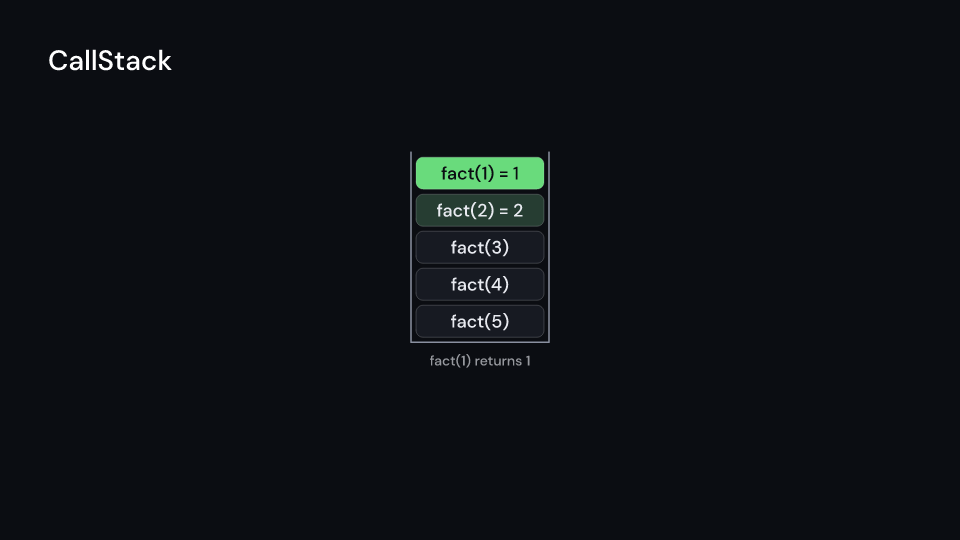
CallStack 8.5 s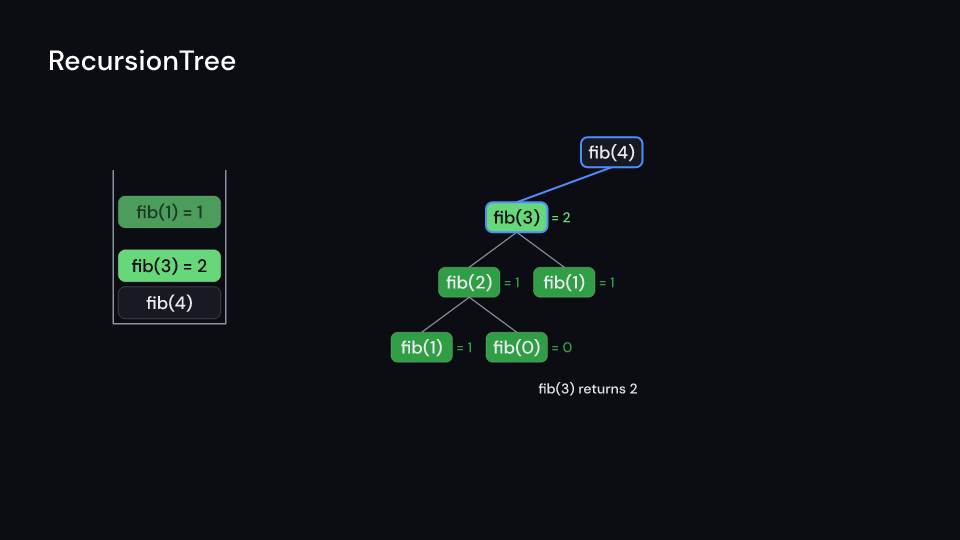
RecursionTree 10.5 suse fframes_kit::prelude::*;
let sum = CallTrace::recurse("sum", 3_u32, |r, n| if n == 0 { 0 } else { n + r.call(n - 1) });assert_eq!(sum.calls().len(), 4);assert_eq!(sum.max_stack(), 4);assert_eq!(sum.steps().last().unwrap().note, "sum(3) = 6");
fn recursion<'a>(ui: &mut Ui<'a, '_, '_>, trace: &'a CallTrace) -> Svgr<'a> { let tree = ui.show(RecursionTree { trace: Some(trace), center: (1.6, 0.0), ..ui.defaults() }); let stack = ui.show(CallStack { trace: Some(trace), center: (-4.6, 0.0), notes: false, ..ui.defaults() }); fframes::svgr!(<g>{stack}{tree}</g>)}Components are plain structs. Set the fields you need and fill the rest with ..ui.defaults(): the defaults below come from the current theme (theme. values are fields of Theme).
CallStack
Section titled “CallStack”The call stack of a recursion: a frame for each open call, height pixels tall and wide enough for the longest label, piled up from the bottom of a column capacity frames tall (or as tall as the trace needs), centred on center (units of ui.space). It plays a CallTrace, one step every step_time seconds from delay: a call drops a frame on top, the innermost frame lights up, a returning frame shows its result in colors.found and then rises out. The whole figure fades with enter and exit.
| Field | Type | Default | Description |
|---|---|---|---|
trace |
Option<&CallTrace> |
None |
The recorded calls to play (CallTrace); None draws nothing. |
delay |
f32 |
0.0 |
Seconds after the container’s start before the first step. |
step_time |
f32 |
0.6 |
Seconds each step of the trace takes. |
center |
(f64, f64) |
(0.0, 0.0) |
The middle of the column, in units of ui.space. |
height |
f32 |
64.0 |
Height of a frame in pixels. |
gap |
f32 |
10.0 |
Space between neighbouring frames in pixels. |
capacity |
usize |
0 |
How many frames tall the column is; 0 uses the deepest the trace gets. |
notes |
bool |
true |
Whether the step’s note is written under the stack. |
colors |
CellColors |
CellColors::themed(theme) |
Colours of the frames in each state (colors.found for a returning call). |
frame_color |
Color |
theme.colors.muted |
Colour of the column’s outline. |
value_style |
TextStyle |
value_style |
The font of the call labels. |
small_style |
TextStyle |
theme.typography.caption |
The font of the notes. |
enter |
Option<FadeIn> |
None |
Fade in at the start; None for none. |
exit |
Option<FadeOut> |
None |
Fade out before the end; None for none. |
Feature cs · Source
RecursionTree
Section titled “RecursionTree”The tree of a recursion’s calls: a node for each call, wide enough for the longest label and height pixels tall, spacing pixels between slots and level pixels between depths, centred on center (units of ui.space). It plays a CallTrace, one step every step_time seconds from delay: each call’s node drops in under its caller, the open calls are outlined in path_color with the innermost lit, a returning call shows its result beside it in colors.found, and finished calls keep their result in colors.sorted. The whole figure fades with enter and exit.
| Field | Type | Default | Description |
|---|---|---|---|
trace |
Option<&CallTrace> |
None |
The recorded calls to play (CallTrace); None draws nothing. |
delay |
f32 |
0.0 |
Seconds after the container’s start before the first step. |
step_time |
f32 |
0.6 |
Seconds each step of the trace takes. |
center |
(f64, f64) |
(0.0, 0.0) |
The middle of the tree, in units of ui.space. |
spacing |
f32 |
190.0 |
Pixels between neighbouring node slots in a depth. |
level |
f32 |
130.0 |
Pixels between depths. |
height |
f32 |
60.0 |
Height of a node in pixels. |
notes |
bool |
true |
Whether the step’s note is written under the tree. |
colors |
CellColors |
CellColors::themed(theme) |
Colours of the nodes in each state (colors.found for a returning call, colors.sorted for a finished one). |
edge_color |
Color |
theme.colors.muted |
Colour of the edges between a call and its callees. |
path_color |
Color |
theme.colors.accent |
Colour of the outline of the open calls. |
value_style |
TextStyle |
value_style |
The font of the call labels. |
small_style |
TextStyle |
theme.typography.caption |
The font of the results and notes. |
enter |
Option<FadeIn> |
None |
Fade in at the start; None for none. |
exit |
Option<FadeOut> |
None |
Fade out before the end; None for none. |
Feature cs · Source