
LinearTransform and VectorSum
Cargo featurefeatures = ["math"]
LinearTransform is Manim’s ApplyMatrix on a LinearTransformationScene. It moves a grid
and the two basis vectors from the identity to matrix over run_time, over the
original grid drawn faintly, and writes the matrix at matrix_at with the Matrix
component. VectorSum adds vectors tip to tail: each one moves from origin to the tip
of the one before, then the resultant draws with resultant_enter. apply(m, p) and
towards(m, p) are the matrix product and the interpolation from the identity they use.
Gallery scenes: LinearTransform, VectorSum.
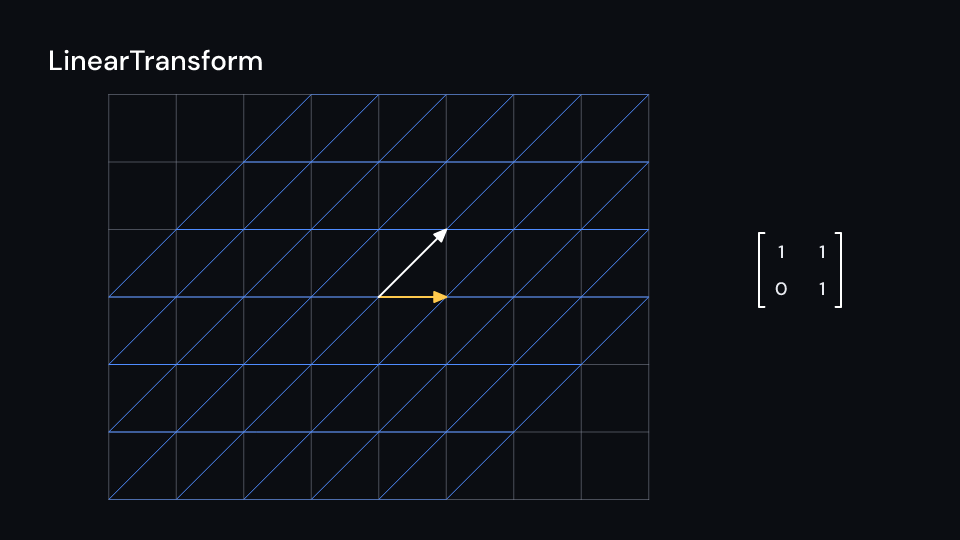
LinearTransform 4 s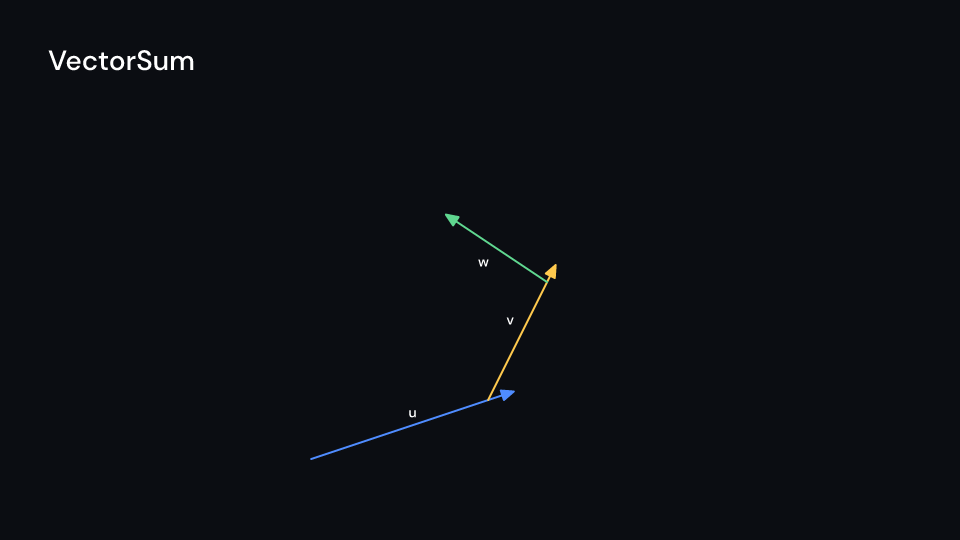
VectorSum 4.5 suse fframes_kit::prelude::*;use fframes_kit::kits::math::apply;
fn figure<'a>(ui: &mut Ui<'a, '_, '_>) -> Svgr<'a> { let shear = ui.show(LinearTransform { matrix: [[1.0, 1.0], [0.0, 1.0]], delay: 1.0, ..ui.defaults() }); let sum = ui.show(VectorSum { vectors: vec![(3.0, 1.0), (1.0, 2.0)], labels: vec!["u".into(), "v".into()], resultant_label: "u + v".into(), delay: 3.5, resultant_enter: Some(Create { delay: 5.0, ..Create::default() }.into()), resultant_label_enter: Some(FadeIn { delay: 5.5, ..FadeIn::default() }), ..ui.defaults() }); svgr!(<g>{shear}{sum}</g>)}
assert_eq!(apply([[1.0, 1.0], [0.0, 1.0]], (2.0, 3.0)), (5.0, 3.0));Components are plain structs. Set the fields you need and fill the rest with ..ui.defaults(): the defaults below come from the current theme (theme. values are fields of Theme).
LinearTransform
Section titled “LinearTransform”A grid of lines and the two basis vectors moved by matrix (Manim’s LinearTransformationScene with ApplyMatrix): from the identity to the matrix over run_time seconds after delay, over the untransformed grid drawn faintly. The grid has a line at every integer of x_range and y_range, in units of ui.space around center, and the moved grid is clipped to its box; key tells the clip paths of two transforms apart. With show_matrix the matrix is written at matrix_at (pixels).
| Field | Type | Default | Description |
|---|---|---|---|
matrix |
Mat2 |
[[1.0, 1.0], [0.0, 1.0]] |
The 2x2 matrix to apply, row by row; its columns are where the basis vectors i and j end up. |
x_range |
Range |
Range::new(-4.0, 4.0, 1.0) |
The grid’s x extent in units of ui.space from center, with a vertical line at every tick. |
y_range |
Range |
Range::new(-3.0, 3.0, 1.0) |
The grid’s y extent in units of ui.space from center, with a horizontal line at every tick. |
center |
(f64, f64) |
(0.0, 0.0) |
Where the grid’s origin sits, in units of ui.space (y up). |
delay |
f32 |
0.0 |
Seconds after the container’s start before the transformation begins. |
run_time |
f32 |
2.0 |
Seconds the grid takes to move from the identity to matrix. |
rate_func |
RateFunc |
RateFunc::default() |
Easing of the movement over its run time. |
line_color |
Color |
theme.colors.accent |
Colour of the moving grid lines; the untransformed grid is drawn faintly in the muted colour. |
stroke_width |
f32 |
theme.stroke.thin |
Grid line width in pixels. |
i_color |
Color |
theme.colors.highlight |
Colour of the basis vector i (to (1, 0)). |
j_color |
Color |
theme.colors.caption |
Colour of the basis vector j (to (0, 1)). |
show_matrix |
bool |
true |
Writes matrix at matrix_at when true. |
matrix_at |
(f32, f32) |
(1600.0, 200.0) |
Where the written matrix sits, in pixels of the canvas. |
enter |
Option<EnterAnim> |
None |
How the grids and the vectors appear. |
matrix_enter |
Option<FadeIn> |
Some(FadeIn::themed(theme)) |
Fade in of the written matrix’s entries; None shows them from the start. |
key |
Option<&str> |
None |
Names the clip path when two transforms share a frame; None for the default. |
Feature math · Source
VectorSum
Section titled “VectorSum”Vectors added tip to tail (Manim’s vector addition): every vector starts at origin, then moves over run_time seconds after delay to the tip of the one before, and the resultant from origin to the last tip draws with resultant_enter (a Create delayed past the move). Vectors are in units of ui.space; labels are written at the middle of the vectors, on their left, and resultant_label on the side of the resultant away from them.
| Field | Type | Default | Description |
|---|---|---|---|
vectors |
Vec<(f64, f64)> |
Vec::new() |
The vectors (dx, dy) in units of ui.space (y up), added in order tip to tail. |
origin |
(f64, f64) |
(0.0, 0.0) |
Where the first vector starts and the resultant begins, in units of ui.space. |
colors |
Vec<Color> |
Vec::new() |
Colours of the vectors in turn; empty for the theme’s accent and highlight. |
labels |
Vec<Cow<str>> |
Vec::new() |
Text for each vector in turn, written at its middle; a vector without one has none. |
delay |
f32 |
0.0 |
Seconds after the container’s start before the vectors begin to move into place. |
run_time |
f32 |
1.5 |
Seconds the vectors take to move to the tip of the one before. |
rate_func |
RateFunc |
RateFunc::default() |
Easing of the move over its run time. |
resultant |
bool |
true |
Draws the sum from origin to the last tip when true. |
resultant_color |
Color |
theme.colors.title |
Colour of the resultant. |
resultant_label |
Cow<str> |
Cow::Borrowed("") |
Text written beside the resultant; empty for none. |
enter |
Option<EnterAnim> |
None |
How each vector appears; None shows them from the start. |
resultant_enter |
Option<EnterAnim> |
None |
How the resultant appears; None shows it from the start. |
labels_enter |
Option<FadeIn> |
None |
Fade in of the vector labels; None for none. |
resultant_label_enter |
Option<FadeIn> |
None |
The resultant’s label also fades with this, to wait for the resultant. |
Methods:
fn total(&self) -> (f64, f64): The sum of the vectors.
Feature math · Source