
TreeTrace holds the steps of a binary tree. Each TreeStep has the nodes (an id, a label
and the ids of the left and right child), the root, the highlighted nodes, the path walked
to them, a found node and a note. Every step is laid out once when the trace is made, with
layout::tidy_tree; a node with one child leans it to its side.
with_layout(TreeLayout::Tree) lays the steps out again with the tree layout of the graph
layouts (GraphLayout::Tree): the children are centred under their parent, so a single child
sits straight below it.
TreeTrace::bst(&values)starts a search tree with the values inserted.insert,searchandremovewalk down from the root one node a step, noting which way they go;removereplaces a node with two children by the smallest node on its right.TreeTrace::max_heap(&values)andmin_heapstart a heap.pushadds at the bottom and sifts up,poptakes the root and sifts the last node down, a compare and a swap a step. Nodes keep their values, so swapped nodes trade places.
TreeView draws the trace as round nodes radius pixels, spacing pixels between slots and
level pixels between depths. Highlighted nodes light up, the path is outlined, a found node
turns green, nodes slide to their new places (two swapped nodes pass side by side), new ones
drop in and removed ones fade. Gallery scenes: TreeView (a search tree: an insert, a search
and a remove), Heap (a push and a pop).
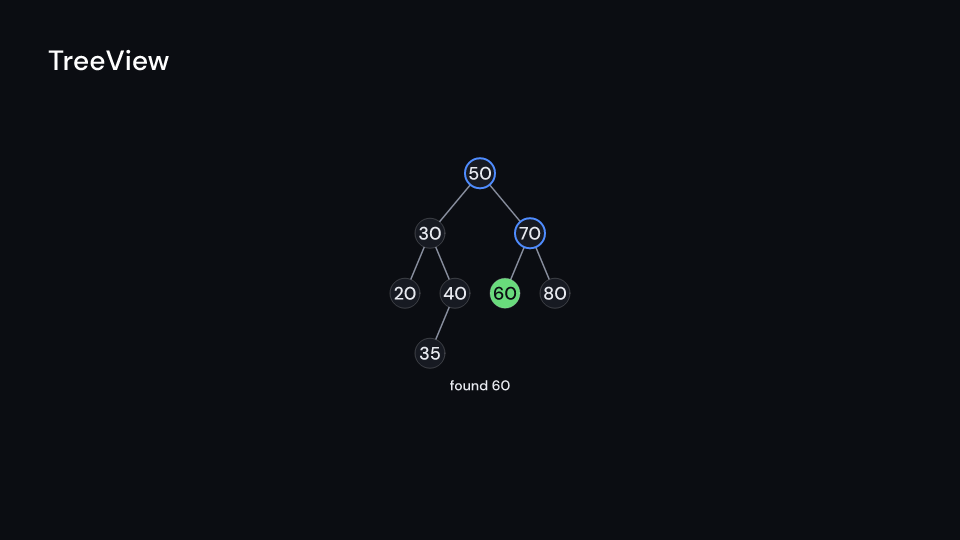
TreeView 13 s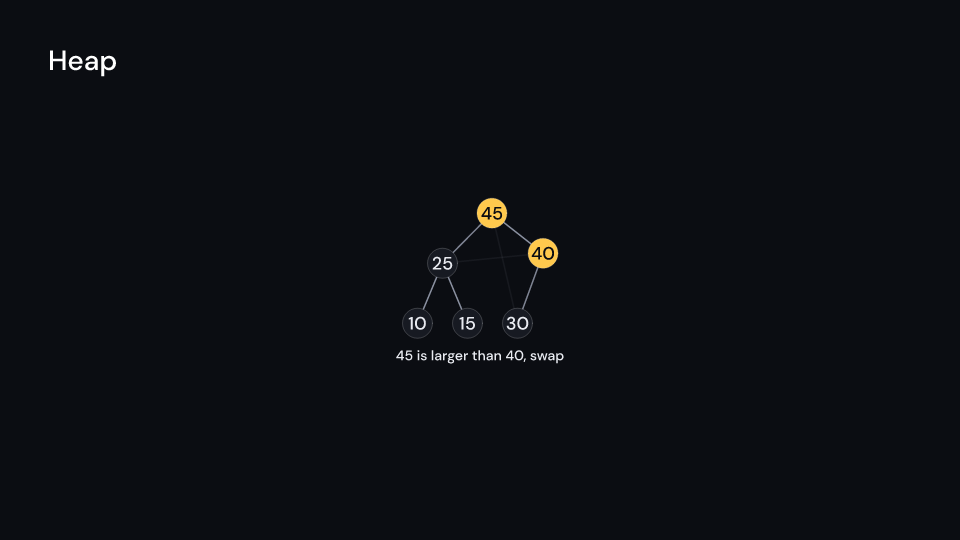
Heap 10 suse fframes_kit::prelude::*;
let bst = TreeTrace::bst(&[50, 30, 70]).insert(40).remove(30).finish();let last = bst.steps().last().unwrap();assert_eq!(last.nodes.len(), 3);assert_eq!(last.note, "40 moves up");
fn tree<'a>(ui: &mut Ui<'a, '_, '_>, trace: &'a TreeTrace) -> Svgr<'a> { ui.show(TreeView { trace: Some(trace), step_time: 0.8, ..ui.defaults() })}Components are plain structs. Set the fields you need and fill the rest with ..ui.defaults(): the defaults below come from the current theme (theme. values are fields of Theme).
TreeView
Section titled “TreeView”A binary tree: round nodes radius pixels with their values, spacing pixels between neighbouring slots and level pixels between depths, centred on center (units of ui.space). It plays a TreeTrace, one step every step_time seconds from delay: the nodes a step looks at light up, the path to them is outlined, nodes slide to their new places as the tree changes (swapped heap nodes pass each other), new nodes drop in and removed ones fade. The whole figure fades with enter and exit.
| Field | Type | Default | Description |
|---|---|---|---|
trace |
Option<&TreeTrace> |
None |
The recorded steps to play (TreeTrace); None draws nothing. |
delay |
f32 |
0.0 |
Seconds after the container’s start before the first step. |
step_time |
f32 |
0.8 |
Seconds each step of the trace takes. |
center |
(f64, f64) |
(0.0, 0.0) |
The middle of the tree, in units of ui.space. |
spacing |
f32 |
100.0 |
Pixels between neighbouring node slots in a depth. |
level |
f32 |
120.0 |
Pixels between depths. |
radius |
f32 |
30.0 |
Radius of a node in pixels. |
notes |
bool |
true |
Whether the step’s note is written under the tree. |
colors |
CellColors |
CellColors::themed(theme) |
Colours of the nodes in each state (looked at, moved, found). |
edge_color |
Color |
theme.colors.muted |
Colour of the edges between nodes. |
path_color |
Color |
theme.colors.accent |
Colour of the outline of the path to the nodes a step looks at. |
value_style |
TextStyle |
value_style |
The font of the values in the nodes. |
small_style |
TextStyle |
theme.typography.caption |
The font of the notes. |
enter |
Option<FadeIn> |
None |
Fade in at the start; None for none. |
exit |
Option<FadeOut> |
None |
Fade out before the end; None for none. |
Feature cs · Source