
Graph, GraphTrace and GraphView
Cargo featurefeatures = ["cs"]
Graph holds named nodes and edges, directed or not. Graph::new(&names, &edges, directed)
gives every edge weight 1; Graph::weighted takes (from, to, weight) and shows the
weights. Nodes are placed in layers along the edges with layout::layered; at places
them yourself, in the same slots and layers (fractions are fine), and
layout(&GraphLayout::KamadaKawai, 2.0) places them with one of the shared graph layouts
(Circular, KamadaKawai, Planar, Random, Shell, Spectral, Spiral, Spring,
Partite, Tree or a function of your own), the farthest node scale slots and layers from
the middle.
GraphTrace records a search over a graph, one GraphStep per visit or discovery: the
current node, the frontier, the finished nodes, the tree edges that reached each node, the
edge being looked at, the distances and a note.
GraphTrace::bfs(&graph, start)keeps a queue and visits by distance in edges;GraphTrace::dfs(&graph, start)keeps a stack, goes deep first and backs out;GraphTrace::dijkstra(&graph, start)takes the closest unfinished node each time and notes each relaxation (T: 3 + 5 is not below 4).
order() is the order nodes were finished in. GraphView draws the trace: the frontier,
current and finished nodes in the cell colours, tree edges in tree_color, the active edge
in active_color, distances above the nodes (∞ until reached) for Dijkstra, and the
frontier (queue: B, C) and the note under the graph. Weights sit on the middle of their
edge, on a small weight_fill plate (the distances have one too), so the edge never runs
through the digits. With curved every edge is an arc. In a directed graph, a backward edge
(one that closes a cycle, found by a depth first search from the first node; the layered
layout points these up) always curves, by a third of its length, so it passes beside the
forward edges instead of over them; two edges between the same nodes bend apart. Gallery
scenes: GraphView (BFS and DFS side by side), Dijkstra, WeightedGraph (Dijkstra on a
graph with backward edges, and on a ring placed by GraphLayout::Circular with curved).
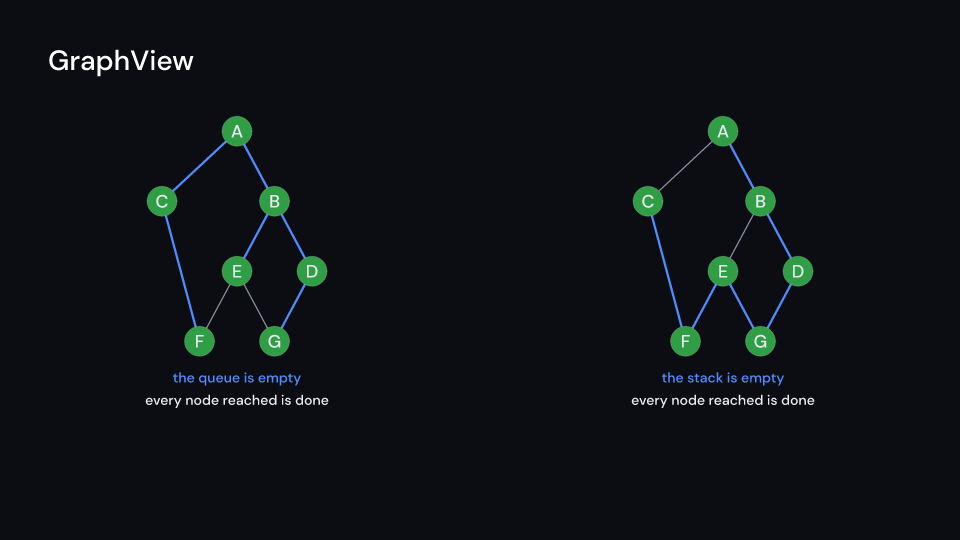
GraphView 10.5 s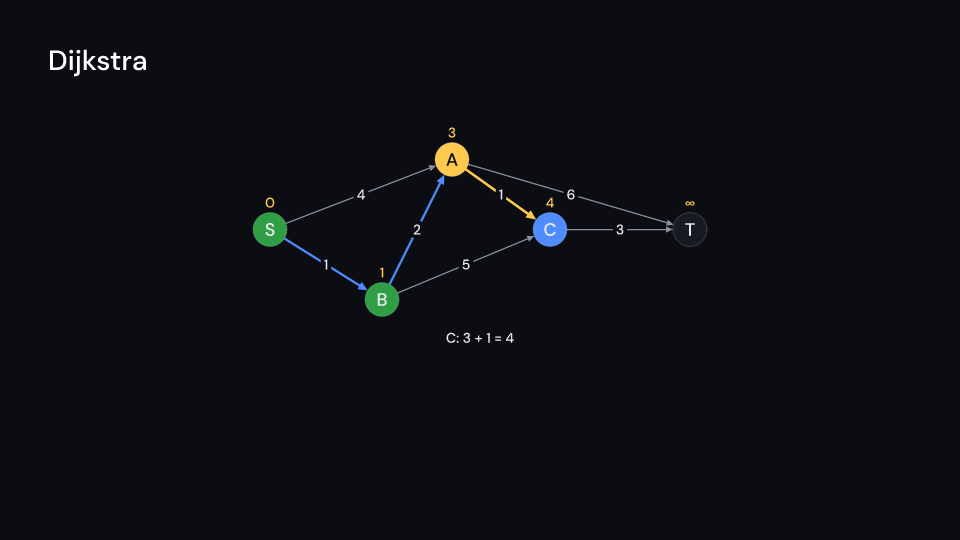
Dijkstra 13 s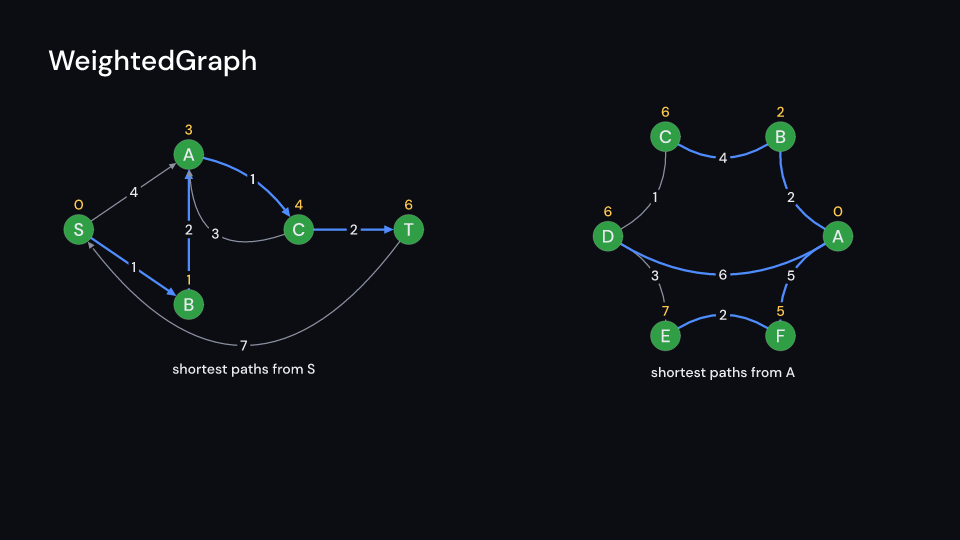
WeightedGraph 9 suse fframes_kit::prelude::*;
let graph = Graph::new(&["A", "B", "C", "D"], &[(0, 1), (0, 2), (1, 3)], false);let bfs = GraphTrace::bfs(&graph, 0);assert_eq!(bfs.order(), [0, 1, 2, 3]);
let ring = Graph::new(&["A", "B", "C"], &[(0, 1), (1, 2), (2, 0)], true) .layout(&GraphLayout::Circular, 1.0);// on a circle of radius 1, the first node on the rightassert!(ring.positions.iter().all(|&(x, y)| (x.hypot(y) - 1.0).abs() < 1e-9));assert!(ring.positions[0].0 > 0.99);
fn search<'a>(ui: &mut Ui<'a, '_, '_>, trace: &'a GraphTrace) -> Svgr<'a> { ui.show(GraphView { trace: Some(trace), step_time: 0.6, ..ui.defaults() })}Components are plain structs. Set the fields you need and fill the rest with ..ui.defaults(): the defaults below come from the current theme (theme. values are fields of Theme).
GraphView
Section titled “GraphView”A graph search: round nodes radius pixels with their names, spacing pixels between slots and level pixels between layers, centred on center (units of ui.space). It plays a GraphTrace, one step every step_time seconds from delay: the current node lights up, nodes waiting in the frontier take colors.moved, finished ones colors.sorted, the edge followed lights up and the search tree’s edges thicken. A long edge bends round the nodes in its way, and the two edges of a pair that point both ways bend apart. With curved every edge is an arc. A backward edge of a directed graph (one that points up against the layers, or left within a layer) always curves, wide enough to pass beside the forward edges instead of over them. Weights sit on the middle of their edge, on a small weight_fill plate. Distances (Dijkstra) are written above the nodes, the frontier (queue: A, B) and the note under the graph. The whole figure fades with enter and exit.
| Field | Type | Default | Description |
|---|---|---|---|
trace |
Option<&GraphTrace> |
None |
The recorded search steps to play (GraphTrace); None draws nothing. |
delay |
f32 |
0.0 |
Seconds after the container’s start before the first step. |
step_time |
f32 |
0.8 |
Seconds each step of the trace takes. |
center |
(f64, f64) |
(0.0, 0.0) |
The middle of the graph, in units of ui.space. |
spacing |
f32 |
170.0 |
Pixels between neighbouring node slots in a layer. |
level |
f32 |
150.0 |
Pixels between layers. |
radius |
f32 |
34.0 |
Radius of a node in pixels. |
frontier |
bool |
true |
Whether the frontier (queue: A, B) is written under the graph. |
notes |
bool |
true |
Whether the step’s note is written under the graph. |
curved |
bool |
false |
Every edge an arc, not only the backward ones and the pairs. |
colors |
CellColors |
CellColors::themed(theme) |
Colours of the nodes in each state (current, waiting, finished). |
edge_color |
Color |
theme.colors.muted |
Colour of the edges. |
tree_color |
Color |
theme.colors.accent |
Colour of the edges of the search tree built so far. |
active_color |
Color |
theme.colors.highlight |
Colour of the edge being followed. |
dist_color |
Color |
theme.colors.highlight |
Colour of the distances written above the nodes. |
weight_fill |
Color |
theme.colors.background |
The plate behind a weight, so the edge does not run through the digits. |
value_style |
TextStyle |
value_style |
The font of the node names and weights. |
small_style |
TextStyle |
theme.typography.caption |
The font of the distances, frontier and notes. |
enter |
Option<FadeIn> |
None |
Fade in at the start; None for none. |
exit |
Option<FadeOut> |
None |
Fade out before the end; None for none. |
Feature cs · Source